"Police are trained professionals, you as a simple lowly civilian do not have the super-human skills to match the hard-core training that the police and military possess and as such are unqualified to have a firearm."
How often do we hear or see a form of the above statement?
Just how wrong is that statement?
Please consider posting a reply with more information, statistics, or videos.
Showing posts with label firearms. Show all posts
Showing posts with label firearms. Show all posts
Monday, October 1, 2012

Thursday, June 28, 2012
Five Types Of Looters?
An excellent article on a blog I have not seen before (may add to the list). Visit and read, it is worth the time.
secretsofurbansurvival.com
Five Types Of Looters You Must Prepare For

secretsofurbansurvival.com
Five Types Of Looters You Must Prepare For
Get Into The Heads of Those to Watch For
In a collapse, not all looters are created equally. There will be varying degrees of how far a person is willing to go to survive. But even the best, most honest of people will be desperate for food and water. It’s a good idea to consider who might be approaching your doorstep before trouble shows. Stan, the Family Man Toni, the Prisoner Scorpion, the Gang Member John, the Tactically Trained Brenda, the Naysayer

Sunday, June 24, 2012
Personal critical perspective, The Kel-Tec PF-9 subcompact 9mm pistol
Personal critical perspective, The Kel-Tec PF-9 subcompact 9mm pistol.

Our additions to the collection, a pair of consecutively numbered Kel-tec PF9 pistols.
The Kel-Tec PF-9
Kel-Tec CNC Industries, an interesting little power-house of a manufacturer, the third largest handgun producer in the U.S. George Kellgren as Chief Engineer will likely continue to make a huge impact in the firearms industry for many more years.
This example of a subcompact pistol, taking the features and design work from the P-3AT and his earlier P11, is outselling the competition by a large margin.
Personal - This is a small lightweight cary pistol that has many points that make it well suited for concealed carry.
Small and thin
Can fit in a pocket
Quick reliable operation
Simple take-down
Double Action
Reasonable trigger and reasonable accuracy
Capable of shooting hand-loaded ammunition
The PF9 fits this list well and I was shocked at how accurate this little pip-squeak actually is on the range.
I do not “enjoy" shooting this pistol, more on this as I progress, I don’t have to love this pistol its reason for existing in the collection has nothing to do with recreation or even open carry, but a down and dirty backup or concealed carry.
Function - Using reloads, white box, bulk Remington and federal and my premium ammunition all worked with excellent results and without incident. I found a distressing problem with feeding with lead bullets as they would simply not function reliably, ever, this is not a huge loss because the pistol will not be used all that often and saving money on ammunition is not the priority.
The PF9 is a miniature 9mm with a high-power inspired tilting lock barrel that keeps the size very very small for a full powered handgun round.
I guess you could call the pistol ambidextrous but there are just not any features to speak of, at least not many that need any ambidextrous access for the use this pistol will fill.
The magazine release could be an issue, as it is with any small pistol there is simply just not much room and the magazine release button is at thumb level. Thinking clearly about the issue this pistol is just not designed nor would it be used for fast magazine changes - it is a “holy shit” self defense handgun for concealment - a concealed option with a full-power punch.
Take-down for cleaning is simple but not as fast as you would get with a more feature packed full-sized pistol. There is an unusual pull-pin that requires the rim of a case or a thin pry tool to remove the subsequent take-down is simple.
This pistol actually has a small mini-hammer in a protected rear slop that is double action only and non-recprocating - that is, it will not reset until the firearm is operated or the slide is actuated again.
Design flaws - The double action trigger on this pistol is smooth enough but is long as would be expected but exists inside a small trigger guard and is “pinch-prone” for larger fingers. The trigger has an exaggerated forward and lower angle with a relatively thin and pointed end. In examining the trigger it looks very similar to the profile of the trigger from the Russian Makarov pistol, but for whatever reason, unlike the Mak this tends to catch the trigger finger inside of the trigger guard and of course leaves little room in the guard for large fingers.
The non-recprocating hammer in double action is simply annoying - if it has to be double action with no single action feature at least make it capable of snapping twice if needed on a primer that is not cooperating as needed.
Small and lightweight, great for carry, painful and at best excessively “snappy” with this full sized round.
Magazine release at thumb-level can be a problem for some, in this case I would think that a rear frame mounted bottom of the magazine release would actually make changing the magazines quicker, a release similar to the Makarov pistol.
While not exactly a design flaw the heavy part of the pistol, the slide, is of course on top, the lightweight handle is very lightweight so the force of the 9mm is increased in its leverage making the pistol have a very unpleasant hard “snap” when firing, I found that after as little as 50 rounds I want to put it back in the box and go to another handgun, for most normal people that would be about a magazine of rounds down range.
Quality - Quality, safe-to-use "state of the art” manufacturing but the fit and finish tends to be, well, kel-tec ish, functional but not all that finished rough and ugly would be descriptive.
Caliber / Ammunition - 9x19 in a subcompact - damn thats both useful and painful. The PF-9 will accept +P ammunition with the recommendation of using it only “from time to time” +P - double damn!
Ergonomics - Ergonomic design to this pistol would be like talking about ergonomics for a smart-phone, it is just not the primary aim. This handgun’s design revolves around the ability to be small and lightweight in that it is tops in the market.
Current production - Production of the PF9 is priority out of the factory in Cocoa, Florida, while you cannot get some of the more interesting firearms due to backlogs this pistol seems to never have much of a lag in availability. The US factory produces a wide range of colors and finishes including camouflage base colors like dark brown, tan, gray, olive green, navy, and of course black with slides of colors, hard chrome plated and blued.

Nice little plastic boxes come with the pistols as a retail package.

Our additions to the collection, a pair of consecutively numbered Kel-tec PF9 pistols.
The Kel-Tec PF-9
Kel-Tec CNC Industries, an interesting little power-house of a manufacturer, the third largest handgun producer in the U.S. George Kellgren as Chief Engineer will likely continue to make a huge impact in the firearms industry for many more years.
This example of a subcompact pistol, taking the features and design work from the P-3AT and his earlier P11, is outselling the competition by a large margin.
Personal - This is a small lightweight cary pistol that has many points that make it well suited for concealed carry.
Small and thin
Can fit in a pocket
Quick reliable operation
Simple take-down
Double Action
Reasonable trigger and reasonable accuracy
Capable of shooting hand-loaded ammunition
The PF9 fits this list well and I was shocked at how accurate this little pip-squeak actually is on the range.
I do not “enjoy" shooting this pistol, more on this as I progress, I don’t have to love this pistol its reason for existing in the collection has nothing to do with recreation or even open carry, but a down and dirty backup or concealed carry.
Function - Using reloads, white box, bulk Remington and federal and my premium ammunition all worked with excellent results and without incident. I found a distressing problem with feeding with lead bullets as they would simply not function reliably, ever, this is not a huge loss because the pistol will not be used all that often and saving money on ammunition is not the priority.
The PF9 is a miniature 9mm with a high-power inspired tilting lock barrel that keeps the size very very small for a full powered handgun round.
I guess you could call the pistol ambidextrous but there are just not any features to speak of, at least not many that need any ambidextrous access for the use this pistol will fill.
The magazine release could be an issue, as it is with any small pistol there is simply just not much room and the magazine release button is at thumb level. Thinking clearly about the issue this pistol is just not designed nor would it be used for fast magazine changes - it is a “holy shit” self defense handgun for concealment - a concealed option with a full-power punch.
Take-down for cleaning is simple but not as fast as you would get with a more feature packed full-sized pistol. There is an unusual pull-pin that requires the rim of a case or a thin pry tool to remove the subsequent take-down is simple.
This pistol actually has a small mini-hammer in a protected rear slop that is double action only and non-recprocating - that is, it will not reset until the firearm is operated or the slide is actuated again.
Design flaws - The double action trigger on this pistol is smooth enough but is long as would be expected but exists inside a small trigger guard and is “pinch-prone” for larger fingers. The trigger has an exaggerated forward and lower angle with a relatively thin and pointed end. In examining the trigger it looks very similar to the profile of the trigger from the Russian Makarov pistol, but for whatever reason, unlike the Mak this tends to catch the trigger finger inside of the trigger guard and of course leaves little room in the guard for large fingers.
The non-recprocating hammer in double action is simply annoying - if it has to be double action with no single action feature at least make it capable of snapping twice if needed on a primer that is not cooperating as needed.
Small and lightweight, great for carry, painful and at best excessively “snappy” with this full sized round.
Magazine release at thumb-level can be a problem for some, in this case I would think that a rear frame mounted bottom of the magazine release would actually make changing the magazines quicker, a release similar to the Makarov pistol.
While not exactly a design flaw the heavy part of the pistol, the slide, is of course on top, the lightweight handle is very lightweight so the force of the 9mm is increased in its leverage making the pistol have a very unpleasant hard “snap” when firing, I found that after as little as 50 rounds I want to put it back in the box and go to another handgun, for most normal people that would be about a magazine of rounds down range.
Quality - Quality, safe-to-use "state of the art” manufacturing but the fit and finish tends to be, well, kel-tec ish, functional but not all that finished rough and ugly would be descriptive.
Caliber / Ammunition - 9x19 in a subcompact - damn thats both useful and painful. The PF-9 will accept +P ammunition with the recommendation of using it only “from time to time” +P - double damn!
Ergonomics - Ergonomic design to this pistol would be like talking about ergonomics for a smart-phone, it is just not the primary aim. This handgun’s design revolves around the ability to be small and lightweight in that it is tops in the market.
Current production - Production of the PF9 is priority out of the factory in Cocoa, Florida, while you cannot get some of the more interesting firearms due to backlogs this pistol seems to never have much of a lag in availability. The US factory produces a wide range of colors and finishes including camouflage base colors like dark brown, tan, gray, olive green, navy, and of course black with slides of colors, hard chrome plated and blued.

Nice little plastic boxes come with the pistols as a retail package.
Thursday, June 7, 2012
Personal Critical Review - Savage Mark II FV-SR Bolt action .22 LR rifle
Personal Critical Review - Savage Mark II FV-SR Bolt action .22 LR rifle

Personal - I have posted in the past about how the lowly .22 lr is my "secret sin,” to this day the simple act of hunting, shooting or plinking with .22 firearms is my “hands down” favorite way to spend my shooting time.
In the last few years I have been spending quite a bit of money and time thinking about, researching, testing and shooting to find the “best .22 rifle” for prepping. I am never sure just what makes something “the best” because the subjective nature of our personal bias and the almost endless applications that could be applied to test “the best” it is an enigma.
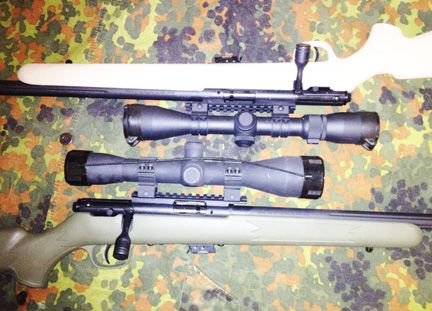
Because I was never happy with the accuracy of the semi-auto rifles I got rid of all but two and replaced them with bolt action rifles two of them you see above. I habitually and continually end up with the bolt action .22 rifles again and again. Even with the recent and mostly successful try with the Marlin autoloading .22 rifles - the accuracy was just not in the same class with the bolt actions.
Function - Mongo grab bolt, Mongo turn bolt, Mongo pull trigger with bugger hook, fire stick go BOOM there is something elegant in the simple function of the bolt action rifles.

The top rifle is wearing a 3x9 one inch Nikon Buckmasters and the bottom rifle in green is attached to a fixed 6 power scope with a 30 mm tube. The rifles come with the plastic stocks shown, but the colors we added later. The Savage is simply excellent in it’s reliable function, the five round magazine fed without scraping or deformation and sent the rounds perfectly into the chamber.
This Savage .22 is similar to just about any other bolt action I have ever fired with one BIG addition, this rifle features an over-sized bolt handle that has proved to be worthy of mentioning and making a big review point about. Check out that Weaver/Picatinny type rail mount, that comes with the factory rifle.

Quality - Top notch high quality fluted barrel, the magazine release is a bit cheesy as is the cheep plastic stock. We were forced to use sand paper an a big dowel to sand out the barrel channel in the cheep stock to get a reliable free-float. The Savage Mark II FV-SR has a steel receiver made of good quality material as is the bolt itself. Both the receiver and bolt are a bit typical in the lack of refined edge de-burring, finishing work, and polish (I guess we just cannot expect what was normal in the 1950’s). The magazine is made of steel and is of high quality and as described works great.
Caliber/Ammunition - .22 LR is comparatively inexpensive ammunition with almost no recoil. Of course bulk-box .22 LR is available at any big-box store great fun for the range and can be reasonably accurate. If you choose target grade ammunition try out several types, speed, weight and brand for accuracy that is often hard to believe. High velocity .22 LR is effective for hunting and available in hollow points that actually work at shorter ranges.

Did I mention accurate - how about 10 rounds at 25 yards... I added that green square to gauge the measurement, that is an inch! This target was punched with a premium target-grade lead bullet selection, the best of 12 different brands, weights, and speeds (FPS) we tested.
Use - Easy to strip and clean, but the main attractant is the adjustable “Accu-trigger” I cannot say how impressed I have been with this addition to Savage products, it takes this little bolt action to the next level. One nice touch is that this particular rifle comes with a STANDARD scope mount already factory installed anything is better than the stupid air gun cuts that are normal.
Current production - Available now, have your local gun shop - order yourself one.
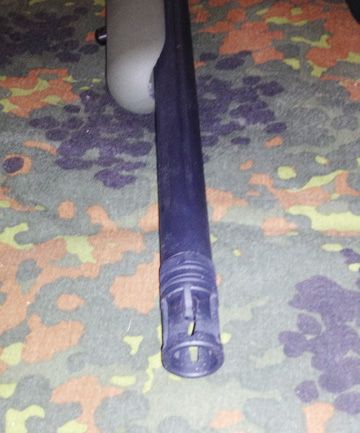
Additional points - This is a silencer ready rifle with threads at the end of the barrel for 1/2 28 and are machined true to the barrel (important to prevent baffle strikes). I was never a big fan of “silencers” I remember the ones from the 1980’s as heavy, easy to damage, and just not all that effective (far louder than any of the movie crap). I have several friends and two relatives that have become “converts” to the “brotherhood of science” and took the plunge and got the BATFE stamp - I am suitably impressed with the modern silencers available now that I am considering filling out paperwork myself. Below is the little rifle with a typical AR birdcage used here to protect the threads.


Personal - I have posted in the past about how the lowly .22 lr is my "secret sin,” to this day the simple act of hunting, shooting or plinking with .22 firearms is my “hands down” favorite way to spend my shooting time.
In the last few years I have been spending quite a bit of money and time thinking about, researching, testing and shooting to find the “best .22 rifle” for prepping. I am never sure just what makes something “the best” because the subjective nature of our personal bias and the almost endless applications that could be applied to test “the best” it is an enigma.
Because I was never happy with the accuracy of the semi-auto rifles I got rid of all but two and replaced them with bolt action rifles two of them you see above. I habitually and continually end up with the bolt action .22 rifles again and again. Even with the recent and mostly successful try with the Marlin autoloading .22 rifles - the accuracy was just not in the same class with the bolt actions.
Function - Mongo grab bolt, Mongo turn bolt, Mongo pull trigger with bugger hook, fire stick go BOOM there is something elegant in the simple function of the bolt action rifles.
The top rifle is wearing a 3x9 one inch Nikon Buckmasters and the bottom rifle in green is attached to a fixed 6 power scope with a 30 mm tube. The rifles come with the plastic stocks shown, but the colors we added later. The Savage is simply excellent in it’s reliable function, the five round magazine fed without scraping or deformation and sent the rounds perfectly into the chamber.
This Savage .22 is similar to just about any other bolt action I have ever fired with one BIG addition, this rifle features an over-sized bolt handle that has proved to be worthy of mentioning and making a big review point about. Check out that Weaver/Picatinny type rail mount, that comes with the factory rifle.
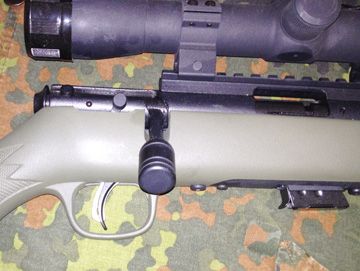
Quality - Top notch high quality fluted barrel, the magazine release is a bit cheesy as is the cheep plastic stock. We were forced to use sand paper an a big dowel to sand out the barrel channel in the cheep stock to get a reliable free-float. The Savage Mark II FV-SR has a steel receiver made of good quality material as is the bolt itself. Both the receiver and bolt are a bit typical in the lack of refined edge de-burring, finishing work, and polish (I guess we just cannot expect what was normal in the 1950’s). The magazine is made of steel and is of high quality and as described works great.
Caliber/Ammunition - .22 LR is comparatively inexpensive ammunition with almost no recoil. Of course bulk-box .22 LR is available at any big-box store great fun for the range and can be reasonably accurate. If you choose target grade ammunition try out several types, speed, weight and brand for accuracy that is often hard to believe. High velocity .22 LR is effective for hunting and available in hollow points that actually work at shorter ranges.

Did I mention accurate - how about 10 rounds at 25 yards... I added that green square to gauge the measurement, that is an inch! This target was punched with a premium target-grade lead bullet selection, the best of 12 different brands, weights, and speeds (FPS) we tested.
Use - Easy to strip and clean, but the main attractant is the adjustable “Accu-trigger” I cannot say how impressed I have been with this addition to Savage products, it takes this little bolt action to the next level. One nice touch is that this particular rifle comes with a STANDARD scope mount already factory installed anything is better than the stupid air gun cuts that are normal.
Current production - Available now, have your local gun shop - order yourself one.
Additional points - This is a silencer ready rifle with threads at the end of the barrel for 1/2 28 and are machined true to the barrel (important to prevent baffle strikes). I was never a big fan of “silencers” I remember the ones from the 1980’s as heavy, easy to damage, and just not all that effective (far louder than any of the movie crap). I have several friends and two relatives that have become “converts” to the “brotherhood of science” and took the plunge and got the BATFE stamp - I am suitably impressed with the modern silencers available now that I am considering filling out paperwork myself. Below is the little rifle with a typical AR birdcage used here to protect the threads.
Friday, July 1, 2011
Reloading for SHTF/TEOTWAWKI (long term storage)
Tips, logic, and observations about reloading and how to have your handloaded ammunition stand the test of time and reliability.

You are a slob reloader if:
If you fit any of the above, stop reading now and go play out in the street... and if there is any justice in the world you will only kill yourself and not someone who does not deserve to land on the Darwin awards list.
Unlike some ill informed yuppie “survival” sources I am going to give you the researched and documented information you need to safely and reliably load quality ammunition for long term storage.
Safety is you primary concern and should stay priority at all times, an “anal rententive” reloader is a safe reloader.
Starting with primers.
Primer based slam-fires are not a myth this is a well documented FACT any source that attempts to propose that primers are not all that different and information can be “safely ignored” is giving dangerous advice. Free-floating firing pins in auto-loading firearms can and do cause an accidental “full-auto” condition from time to time. This without a doubt is as dangerous as an “out of battery” detonation. Often the entire magazine will fire without stopping and the panic handling of that out of control firearm is likely to cause an “out of battery” detonation. Again an “out of battery” detonation is known for destroying or severly damaging the firearm and harming nearby people as well as the shooter.
Yes there are real differences in magnum and standard primers (magnum primers have more material and burn longer) and there are thicker metal primer cups used in the “military” primers. Wolf brand primers marked “magnum” rifle primers are actually the thicker cup “military” primers charged as a standard primer. CCI produced “military” primers are the thick cup type and are charged as magnum primers. Use your reloading manual to find the specific use of magnum primers, not all cartridges identified as “magnum” will require a magnum primer. Here is a run down from the reloading manual:
A magnum primer is useful in non-magnum cartridges for specific reasons such as cold weather conditions, but be advised that the loads for this combination must be worked up from the standard 10% drop in powder charge. When magnum primers are substituted for standard primers you can expect two grains of powder power value with rifle and .5 grain of power value with pistol loads - or greater, you must be careful and this is your responsibility to double check with your loading manuals.
Primer brands also have characteristics that make them more or less desirable for your particular uses. Federal primers are noted for consistency and favored by many accuracy minded shooters but are also slightly larger than standard with a sharp edge making them difficult to push into the primer pocket.
Always seat primers slightly deeper than flush/slightly recessed and slightly flattened (but not crushed) a slight compression of the charge pellet agianst the anvil fully into the primer pocket will be best. Often factory primers have a slightly extended anvil base as illustrated in the cross-section below, seating this into the pocket as the upper illustration will compress the primer charge slightly and should allow the primer to seat slightly below flush.

Consider adding a primer pocket cleaning brush and primer pocket uniforming cutter as they clean and uniform the inside well of the primer pocket this will aid in seating as well as remove any contaminants that could cause corrosion (you can forego the cleaning brush if you are using the chemical brass cleaning methods).

It is not uncommon to find primer pocket “crud” that will prevent the primer from seating fully into the pocket a primer pocket brush and a primer pocket cutter/uniformer is almost required when using the Federal large rifle primers.

Shiny, like new primer pocket ready for a new primer.
I do not paint on a sealant to the finished primer, conditions in the dry western states do not dictate that procedure, it may be useful in some rare wet conditions, but I have never had water contamination in any of my non sealed cartridges even in the wet swampy conditions of the gulf coast. It is possibly the most wasteful additional step suggested out in the "internet wild" that has little to no justification. If you don’t expect to have your ammo under fifteen feet of water for three months the primer sealant will only prove to be a problem when it heats and comes off the casing and fouls your bolt face.
One additional warning, some rifles like the HK SL6 and 7 and its brothers the 770 and 630 have extremely violent return and will slam the bolt face hard enough to deform some cases and cause them to fire because the brass in the primer pocket will constrict and ignite the primer pellet charge. Choose and test your brass and primers for reloading carefully.
The cartridge case.
Commonly you will find spent aluminum, brass, and steel cases at the range, contrary to common (and often willfully ignorant) internet drivel steel cases are reloadable and safe to use for handloading (with a possible shorter life) the steel cases are prone to rust formation and therefore best used for “make and shoot” use.
I am not going to go into the pain involved with berdan primed cases or the fact that aluminum cases are dangerous as we have more important issues to review, simply berdan is relaodable but takes aditional steps and time and the primers are not commonly available, aluminum cases are best recycled to avoid problems (try youtube and google for more about berdan primer reloading).
For our basic needs for long term storage brass cases are the most reasonable choice, it is available, easy to work with, and resistant somewhat to corrosion. Brass has its own special types of corrosion, take a look at the below photos, note how brass (and copper) corrosion can look surprisingly like mould on bread.


If you store your ammunition with the above corrosion evident, the storage time of that ammunition will be much, much shorter, the corrosion only gets worse.
The above two photographs show the worst type of corrosion on your brass cases, this corrosion is destructive, the brown/grey uniform corrosion (also known as a brown patina) is benign and can actually protect the bras from additional corrosion. The creeping black, fuzzy light green/grey, and red colored corrosion as you see above is quite destructive and sadly “grows” so once started, severe methods are needed to remove and stop the corrosion process. Destructive corrosion must be removed. Note the use of gloves to prevent contamination from oily fingerprints.
The first order of business is to prepare the brass cases for reloading, I prefer to clean the brass to like-new shiny condition and handle with gloves. My current method is to use a vibrating abrasive but the newer stainless steel media with a wet acid process or the sonic chemical cleaning either may prove to be my next method of cleaning brass cases. Both methods give a brighter and cleaner finish to the brass than the vibratory cleaner with walnut hulls chips. The wet chemical methods do clean the inside walls of the case and the primer pocket, cleaned to a mirror finish no less, saving the step of cleaning primer pockets individually and no annoying packed walnut hulls or bits stuck in the primer hole.
For longevity in storage, cleaning the brass may be the most important step. All of my range scrounged brass is first washed in hot top water and dish soap, I have a screw-on lid container and shake vigorously then place in a colander drain and then repeat without soap until the dirt and contaminates are gone. Set out in the sun and dry and then its time to size and de-cap the brass and then clean to shiny-new.
Case preperation often requires trimming the brass to the correct length, I first size all of the brass in batches and then sort them using the callipers to sort too long from the in-spec brass and trim the too long cases. The correct length of the typical rifle case for example, can dictate if the round will load into the rifle’s chamber or end-up jammed protruding out of battery.

A typical case trimming lathe, notice that a portable hand drill is connected to speed up the trimming of cases.
Component storage.
Cool, dry, dark - the standard for all long term storage, I will add to this, be sure and isolate the active components (primer and powder) from any solvents and fumes, finished ammunition can benefit from this simple rule also, but the active components are very susceptible to damage by fumes, solvents, and oils.
The bullet
A recent question I started to calculate was the type of projectile I wanted in storage, I have a considerable amount of military surplus non-corrosive ammunition with full-metal-jacketed bullets probably the most pathetic choice for self defense. Lets be honest how many “bad guys” will be out there and wearing projectile resistant body armor? Instead of drilling a very small consistent hole in a deer you need to eat to survive - and then watching it bound into the distance never to be seen again -would you not prefer to have a premium preforming bullet drop it within 100 yards?
I was given the task of removing some dangerous wild dogs years ago and I stupidly loaded my self-loading .308 with surplus FMJ rounds and every canine I shot center chest and every one ran-off - in one case we found one over a full mile away from where he was shot! I for one would want to drop a dangerous wild dog on the spot. FMJ bullets are just not capable of the shock and consistent terminal performance of a premium bullet. What can we expect - "pointed ogival spitzer tip shape have a tendency to fragment on impact with soft tissue, harder organs, bone or the clothing and/or equipment worn by the individual soldier” but this effect aided by the sections and cannelure (yes the bullets sometimes fold in half and break at the cannelure).
I have seen it proposed that softer tips can cause malfunctions in some rifles and that the deformation of the tip will make a “flyer,” what is interesting is that you can find on-line an several test studies of bullet performance with deformed tips from several rifles including magazine feed, and will find that the accuracy difference is actually less than the diameter of the bullets at 100, 200 and 300 yards. Bullet deformation that will impact the accuracy the most is damage to the base of the bullet look over a few varmint and benchrest groups for more information (or "The Bullets Flight" by Franklin Mann). Simply put the greatest two bullet related issues for accuracy are the base and the exit of the bullet from the barrel. Giving up premium bullets for FMJ for the deformation issue is just following ignorant wives tails - if you have a rifle that will not feed reliably with premium bullets - trade that pig out on a rifle that actually works! Anyone proposing that slight tip (meplat) deformation is equal to massive loss in accuracy has just not done any serious research (a massive problem with many delusional and ignorant yuppie survivalists).
Premium bullets are available in bulk for prices not that much higher than bulk FMJ when you look at the possible usefulness of the round loaded with a premium bullet (at the time of writing this Graf and Sons has .308 150 gr. FMJ for $20.59 per 100 and Lead Tip 150 gr. for $20.99 $18.99 on sale!). In the last year I have only purchased premium bullets of various types like Silver tips, Lead tips, hollow points, and have produced by swaging sectioned, frangible, and hollow point bullets. The FMJ bullets are just regulated to field and range practice, for very special needs there are loose bulk armor penetrating small arms bullets available at many gun shows and on-line, they are legal to possess and can be loaded when the need arrises.

Premium 9mm (.355) 121 gr. lead tip hollow point bullets ready to load.
Loading the final cartridge.

I always seat to standard lengths that fit all the loading devices (clips, magazines, and tubes) for that round and crimp using Lee’s factory crimp dies. This is a choice based on the possible need to use “anything” in the collection in “any” rifle and from my testing and the testing of others the Lee factory crimp dies actually improve accuracy for standard use loads. I do have quite a bit of storage ammunition that is made specifically for a longer range scoped heavy barrel .308, but all of the ammo will work in all of the .308 rifles in a pinch.
There is from time to time the suggestion that “tar sealed” bullets are premium for storage, not only is the procedure difficult and time consuming but the results are best described as “dirty as a five dollar crack whore.” I see no reason to seal the bullets myself, I use a crimp die that I think accomplishes this well, but if I were to take the time - the method of applying a thin layer of melted paraffin wax to the inside with a q-tip before pouring the powder and seating the bullet I think has some merit. Glue, tar, paint, and other sealing compounds are all future contaminates.
Long term storage
Back in the 1980s a strange little book came to my attention, I remember that he suggested placing your ammo into military ammunition boxes and then covering the boxes with fiberglass and resin (a hot procedure due to chemical heating) for storage underground. Can you imagine the effort it would take to open that box? Hey guys wait with the raping and looting I need to get my ammo out! I have to chuckle about the strange ideas we see every day.
I prefer to also box all the ammunition into containers like the Midway or Top Brass cardboard boxes (similar to factory boxes) or into the plastic storage boxes like the Berry’s or case-guard. All of the ammunition is stored in three ways, in air sealed tool lockers, in vacuum packed “grab bags” and sealed PVC pipe for burial catches.
Now we do want the optimum conditions, again they are cool, dry, dark and one addition, clean. I do prefer the typical blank cardboard box as it is non-reactive and is not tightly air sealed, I have some corrosion on some green soft plastic “battle packs” of Portuguese ammunition that clearly they sealed with some moisture inside the “battle packs” obviously moisture is a major factor in brass corrosion and this has allowed some corrosion to damage the brass in the packs obviously a desiccant packet would have helped.
I have several PVC storage containers, what bothers me most about this particular method is not that it does not work - in fact it works very well - it is the fact that it is difficult to open and takes time even with the correct tools. I keep thinking of a quote but I do not remember the source “by the time you put your guns into the ground it was long past the time to start using them!'

You are a slob reloader if:
- Cigarette hanging off the lips
- Beer in one hand
- Phone in one hand
- Dirty lead stained fingertips
- Food in one hand
- Think that the reloading max charge is “just a suggestion”
- Think any load is wimpy unless it is maxed out
- Think that primer seating flush or lower is “overkill”
- Think you can’t make a mistake because “you been doing this for __ years”
- Don’t understand the need for full length sizing (for first run or auto-loaders)
If you fit any of the above, stop reading now and go play out in the street... and if there is any justice in the world you will only kill yourself and not someone who does not deserve to land on the Darwin awards list.
Unlike some ill informed yuppie “survival” sources I am going to give you the researched and documented information you need to safely and reliably load quality ammunition for long term storage.
Safety is you primary concern and should stay priority at all times, an “anal rententive” reloader is a safe reloader.
Starting with primers.
Primer based slam-fires are not a myth this is a well documented FACT any source that attempts to propose that primers are not all that different and information can be “safely ignored” is giving dangerous advice. Free-floating firing pins in auto-loading firearms can and do cause an accidental “full-auto” condition from time to time. This without a doubt is as dangerous as an “out of battery” detonation. Often the entire magazine will fire without stopping and the panic handling of that out of control firearm is likely to cause an “out of battery” detonation. Again an “out of battery” detonation is known for destroying or severly damaging the firearm and harming nearby people as well as the shooter.
Yes there are real differences in magnum and standard primers (magnum primers have more material and burn longer) and there are thicker metal primer cups used in the “military” primers. Wolf brand primers marked “magnum” rifle primers are actually the thicker cup “military” primers charged as a standard primer. CCI produced “military” primers are the thick cup type and are charged as magnum primers. Use your reloading manual to find the specific use of magnum primers, not all cartridges identified as “magnum” will require a magnum primer. Here is a run down from the reloading manual:
Magnum primers are the appropriate choice for cartridges such as the popular .357 Magnum. Magnum primers work well with large volume cartridge cases, large volumes of powder, and slow burning powders this is also helpful with ball/spherical powders. Use of magnum primers is useful in non-magnum cartridges when extremely cold shooting conditions are encountered. Care should be used with magnum primers as the additional power represented in the primer itself can create overpressure in listed standard loads.
A magnum primer is useful in non-magnum cartridges for specific reasons such as cold weather conditions, but be advised that the loads for this combination must be worked up from the standard 10% drop in powder charge. When magnum primers are substituted for standard primers you can expect two grains of powder power value with rifle and .5 grain of power value with pistol loads - or greater, you must be careful and this is your responsibility to double check with your loading manuals.
Primer brands also have characteristics that make them more or less desirable for your particular uses. Federal primers are noted for consistency and favored by many accuracy minded shooters but are also slightly larger than standard with a sharp edge making them difficult to push into the primer pocket.
Always seat primers slightly deeper than flush/slightly recessed and slightly flattened (but not crushed) a slight compression of the charge pellet agianst the anvil fully into the primer pocket will be best. Often factory primers have a slightly extended anvil base as illustrated in the cross-section below, seating this into the pocket as the upper illustration will compress the primer charge slightly and should allow the primer to seat slightly below flush.

Consider adding a primer pocket cleaning brush and primer pocket uniforming cutter as they clean and uniform the inside well of the primer pocket this will aid in seating as well as remove any contaminants that could cause corrosion (you can forego the cleaning brush if you are using the chemical brass cleaning methods).

It is not uncommon to find primer pocket “crud” that will prevent the primer from seating fully into the pocket a primer pocket brush and a primer pocket cutter/uniformer is almost required when using the Federal large rifle primers.

Shiny, like new primer pocket ready for a new primer.
I do not paint on a sealant to the finished primer, conditions in the dry western states do not dictate that procedure, it may be useful in some rare wet conditions, but I have never had water contamination in any of my non sealed cartridges even in the wet swampy conditions of the gulf coast. It is possibly the most wasteful additional step suggested out in the "internet wild" that has little to no justification. If you don’t expect to have your ammo under fifteen feet of water for three months the primer sealant will only prove to be a problem when it heats and comes off the casing and fouls your bolt face.
One additional warning, some rifles like the HK SL6 and 7 and its brothers the 770 and 630 have extremely violent return and will slam the bolt face hard enough to deform some cases and cause them to fire because the brass in the primer pocket will constrict and ignite the primer pellet charge. Choose and test your brass and primers for reloading carefully.
The cartridge case.
Commonly you will find spent aluminum, brass, and steel cases at the range, contrary to common (and often willfully ignorant) internet drivel steel cases are reloadable and safe to use for handloading (with a possible shorter life) the steel cases are prone to rust formation and therefore best used for “make and shoot” use.
I am not going to go into the pain involved with berdan primed cases or the fact that aluminum cases are dangerous as we have more important issues to review, simply berdan is relaodable but takes aditional steps and time and the primers are not commonly available, aluminum cases are best recycled to avoid problems (try youtube and google for more about berdan primer reloading).
For our basic needs for long term storage brass cases are the most reasonable choice, it is available, easy to work with, and resistant somewhat to corrosion. Brass has its own special types of corrosion, take a look at the below photos, note how brass (and copper) corrosion can look surprisingly like mould on bread.


If you store your ammunition with the above corrosion evident, the storage time of that ammunition will be much, much shorter, the corrosion only gets worse.
The above two photographs show the worst type of corrosion on your brass cases, this corrosion is destructive, the brown/grey uniform corrosion (also known as a brown patina) is benign and can actually protect the bras from additional corrosion. The creeping black, fuzzy light green/grey, and red colored corrosion as you see above is quite destructive and sadly “grows” so once started, severe methods are needed to remove and stop the corrosion process. Destructive corrosion must be removed. Note the use of gloves to prevent contamination from oily fingerprints.
The first order of business is to prepare the brass cases for reloading, I prefer to clean the brass to like-new shiny condition and handle with gloves. My current method is to use a vibrating abrasive but the newer stainless steel media with a wet acid process or the sonic chemical cleaning either may prove to be my next method of cleaning brass cases. Both methods give a brighter and cleaner finish to the brass than the vibratory cleaner with walnut hulls chips. The wet chemical methods do clean the inside walls of the case and the primer pocket, cleaned to a mirror finish no less, saving the step of cleaning primer pockets individually and no annoying packed walnut hulls or bits stuck in the primer hole.
For longevity in storage, cleaning the brass may be the most important step. All of my range scrounged brass is first washed in hot top water and dish soap, I have a screw-on lid container and shake vigorously then place in a colander drain and then repeat without soap until the dirt and contaminates are gone. Set out in the sun and dry and then its time to size and de-cap the brass and then clean to shiny-new.
Case preperation often requires trimming the brass to the correct length, I first size all of the brass in batches and then sort them using the callipers to sort too long from the in-spec brass and trim the too long cases. The correct length of the typical rifle case for example, can dictate if the round will load into the rifle’s chamber or end-up jammed protruding out of battery.

A typical case trimming lathe, notice that a portable hand drill is connected to speed up the trimming of cases.
Component storage.
Cool, dry, dark - the standard for all long term storage, I will add to this, be sure and isolate the active components (primer and powder) from any solvents and fumes, finished ammunition can benefit from this simple rule also, but the active components are very susceptible to damage by fumes, solvents, and oils.
The bullet
A recent question I started to calculate was the type of projectile I wanted in storage, I have a considerable amount of military surplus non-corrosive ammunition with full-metal-jacketed bullets probably the most pathetic choice for self defense. Lets be honest how many “bad guys” will be out there and wearing projectile resistant body armor? Instead of drilling a very small consistent hole in a deer you need to eat to survive - and then watching it bound into the distance never to be seen again -would you not prefer to have a premium preforming bullet drop it within 100 yards?
I was given the task of removing some dangerous wild dogs years ago and I stupidly loaded my self-loading .308 with surplus FMJ rounds and every canine I shot center chest and every one ran-off - in one case we found one over a full mile away from where he was shot! I for one would want to drop a dangerous wild dog on the spot. FMJ bullets are just not capable of the shock and consistent terminal performance of a premium bullet. What can we expect - "pointed ogival spitzer tip shape have a tendency to fragment on impact with soft tissue, harder organs, bone or the clothing and/or equipment worn by the individual soldier” but this effect aided by the sections and cannelure (yes the bullets sometimes fold in half and break at the cannelure).
I have seen it proposed that softer tips can cause malfunctions in some rifles and that the deformation of the tip will make a “flyer,” what is interesting is that you can find on-line an several test studies of bullet performance with deformed tips from several rifles including magazine feed, and will find that the accuracy difference is actually less than the diameter of the bullets at 100, 200 and 300 yards. Bullet deformation that will impact the accuracy the most is damage to the base of the bullet look over a few varmint and benchrest groups for more information (or "The Bullets Flight" by Franklin Mann). Simply put the greatest two bullet related issues for accuracy are the base and the exit of the bullet from the barrel. Giving up premium bullets for FMJ for the deformation issue is just following ignorant wives tails - if you have a rifle that will not feed reliably with premium bullets - trade that pig out on a rifle that actually works! Anyone proposing that slight tip (meplat) deformation is equal to massive loss in accuracy has just not done any serious research (a massive problem with many delusional and ignorant yuppie survivalists).
Premium bullets are available in bulk for prices not that much higher than bulk FMJ when you look at the possible usefulness of the round loaded with a premium bullet (at the time of writing this Graf and Sons has .308 150 gr. FMJ for $20.59 per 100 and Lead Tip 150 gr. for $

Premium 9mm (.355) 121 gr. lead tip hollow point bullets ready to load.
Loading the final cartridge.

I always seat to standard lengths that fit all the loading devices (clips, magazines, and tubes) for that round and crimp using Lee’s factory crimp dies. This is a choice based on the possible need to use “anything” in the collection in “any” rifle and from my testing and the testing of others the Lee factory crimp dies actually improve accuracy for standard use loads. I do have quite a bit of storage ammunition that is made specifically for a longer range scoped heavy barrel .308, but all of the ammo will work in all of the .308 rifles in a pinch.
There is from time to time the suggestion that “tar sealed” bullets are premium for storage, not only is the procedure difficult and time consuming but the results are best described as “dirty as a five dollar crack whore.” I see no reason to seal the bullets myself, I use a crimp die that I think accomplishes this well, but if I were to take the time - the method of applying a thin layer of melted paraffin wax to the inside with a q-tip before pouring the powder and seating the bullet I think has some merit. Glue, tar, paint, and other sealing compounds are all future contaminates.
Long term storage
Back in the 1980s a strange little book came to my attention, I remember that he suggested placing your ammo into military ammunition boxes and then covering the boxes with fiberglass and resin (a hot procedure due to chemical heating) for storage underground. Can you imagine the effort it would take to open that box? Hey guys wait with the raping and looting I need to get my ammo out! I have to chuckle about the strange ideas we see every day.
I prefer to also box all the ammunition into containers like the Midway or Top Brass cardboard boxes (similar to factory boxes) or into the plastic storage boxes like the Berry’s or case-guard. All of the ammunition is stored in three ways, in air sealed tool lockers, in vacuum packed “grab bags” and sealed PVC pipe for burial catches.
Now we do want the optimum conditions, again they are cool, dry, dark and one addition, clean. I do prefer the typical blank cardboard box as it is non-reactive and is not tightly air sealed, I have some corrosion on some green soft plastic “battle packs” of Portuguese ammunition that clearly they sealed with some moisture inside the “battle packs” obviously moisture is a major factor in brass corrosion and this has allowed some corrosion to damage the brass in the packs obviously a desiccant packet would have helped.
I have several PVC storage containers, what bothers me most about this particular method is not that it does not work - in fact it works very well - it is the fact that it is difficult to open and takes time even with the correct tools. I keep thinking of a quote but I do not remember the source “by the time you put your guns into the ground it was long past the time to start using them!'
Saturday, April 2, 2011
Metallic cartridge reloading for beginners, part 2

Kit or no kit?
If you are thinking about the starting kits for hand-loading pistol and rifle, one each for our example, my advice...
I would make my own kit...
If I were to start... knowing what I do now... what would I want, that would shave as much money as possible, and get everything I need to make it reasonable...
Assuming you are going to order from Midway...
Also assuming your are collecting your own brass to reload (and have been picking it up for some time now)
Prices are as of April 2, 2011
- Lee Classic Cast Single Stage Press Product #: 317831 $99.99
- Lee Carbide 3-Die Set 9mm Luger Product #: 140349 $27.99 (comes with shellholder)
- Lee Deluxe Rifle 3-Die Set 270 Winchester #: 279271 $30.99 (comes with shellholder)
- Lee Factory Crimp Die 270 Winchester #: 735849 $11.99
- Lee Factory Crimp Die 9mm Luger #: 557910 $15.99
- Frankford Arsenal Micro Reloading Electronic Powder Scale #: 175512 $36.99
- Lee Primer Pocket Cleaner Product #: 467111 $2.09
- L.E. Wilson Chamfer and Deburring Tool #: 789334 $14.99
- Lee Safety Prime Small and Large Primer #: 548630 $21.99
- RCBS Powder Trickler #: 317787 $13.99
- Frankford Arsenal Reloading Tray #5 #: 536734 $5.99
- Lee Perfect Powder Measure #: 540522 $23.99
- Lyman Case Trimmer #: 795961 $72.99
Items from other places...
First you can make your own case sizing and forming lubricant with a small tube of lanolin and a bottle of castor oil - heat (carefully in the microwave, can we say third degree burns?) together and mix. This is the best lube ever, will even swage bullets, in a pinch castor oil alone works great.
- www.harborfreight.com - 6" DIAL CALIPER $19.99
- www.harborfreight.com - 5 LB. METAL VIBRATOR/TUMBLER ITEM $49.99 on sale! (only if you want clean shiny brass, you can wipe them off with a rag)
- www.harborfreight.com - 25 lbs. Fine Grade Walnut Shell Blast Media $24.99 (only if you want clean shiny brass)
- www.harborfreight.com - 5 Piece Test Probe Set $4.99
Subscribe to:
Posts (Atom)