Showing posts with label Hunting. Show all posts

Thursday, June 7, 2012

Personal Critical Review - Savage Mark II FV-SR Bolt action .22 LR rifle

Personal Critical Review - Savage Mark II FV-SR Bolt action .22 LR rifle


Personal - I have posted in the past about how the lowly .22 lr is my "secret sin,” to this day the simple act of hunting, shooting or plinking with .22 firearms is my “hands down” favorite way to spend my shooting time.

In the last few years I have been spending quite a bit of money and time thinking about, researching, testing and shooting to find the “best .22 rifle” for prepping. I am never sure just what makes something “the best” because the subjective nature of our personal bias and the almost endless applications that could be applied to test “the best” it is an enigma.

Because I was never happy with the accuracy of the semi-auto rifles I got rid of all but two and replaced them with bolt action rifles two of them you see above. I habitually and continually end up with the bolt action .22 rifles again and again. Even with the recent and mostly successful try with the Marlin autoloading .22 rifles - the accuracy was just not in the same class with the bolt actions.

Function - Mongo grab bolt, Mongo turn bolt, Mongo pull trigger with bugger hook, fire stick go BOOM there is something elegant in the simple function of the bolt action rifles.
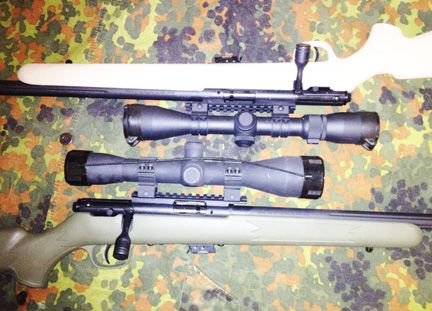


The top rifle is wearing a 3x9 one inch Nikon Buckmasters and the bottom rifle in green is attached to a fixed 6 power scope with a 30 mm tube. The rifles come with the plastic stocks shown, but the colors we added later. The Savage is simply excellent in it’s reliable function, the five round magazine fed without scraping or deformation and sent the rounds perfectly into the chamber.

This Savage .22 is similar to just about any other bolt action I have ever fired with one BIG addition, this rifle features an over-sized bolt handle that has proved to be worthy of mentioning and making a big review point about. Check out that Weaver/Picatinny type rail mount, that comes with the factory rifle.
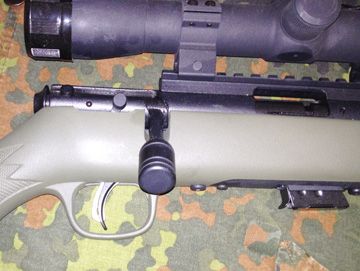


Quality - Top notch high quality fluted barrel, the magazine release is a bit cheesy as is the cheep plastic stock. We were forced to use sand paper an a big dowel to sand out the barrel channel in the cheep stock to get a reliable free-float. The Savage Mark II FV-SR has a steel receiver made of good quality material as is the bolt itself. Both the receiver and bolt are a bit typical in the lack of refined edge de-burring, finishing work, and polish (I guess we just cannot expect what was normal in the 1950’s). The magazine is made of steel and is of high quality and as described works great.


Caliber/Ammunition - .22 LR is comparatively inexpensive ammunition with almost no recoil. Of course bulk-box .22 LR is available at any big-box store great fun for the range and can be reasonably accurate. If you choose target grade ammunition try out several types, speed, weight and brand for accuracy that is often hard to believe. High velocity .22 LR is effective for hunting and available in hollow points that actually work at shorter ranges.


Did I mention accurate - how about 10 rounds at 25 yards... I added that green square to gauge the measurement, that is an inch! This target was punched with a premium target-grade lead bullet selection, the best of 12 different brands, weights, and speeds (FPS) we tested.


Use - Easy to strip and clean, but the main attractant is the adjustable “Accu-trigger” I cannot say how impressed I have been with this addition to Savage products, it takes this little bolt action to the next level. One nice touch is that this particular rifle comes with a STANDARD scope mount already factory installed anything is better than the stupid air gun cuts that are normal.


Current production - Available now, have your local gun shop - order yourself one.


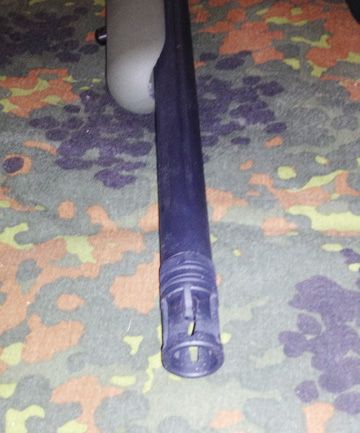
Additional points - This is a silencer ready rifle with threads at the end of the barrel for 1/2 28 and are machined true to the barrel (important to prevent baffle strikes). I was never a big fan of “silencers” I remember the ones from the 1980’s as heavy, easy to damage, and just not all that effective (far louder than any of the movie crap). I have several friends and two relatives that have become “converts” to the “brotherhood of science” and took the plunge and got the BATFE stamp - I am suitably impressed with the modern silencers available now that I am considering filling out paperwork myself. Below is the little rifle with a typical AR birdcage used here to protect the threads.

Monday, April 4, 2011

Fishing the small waterways in the Western US


Brown trout
Abundant from high mountain streams to broad rivers

Brook trout
They are typically found in higher elevation lakes, beaver dams and streams.

Fishing for trout in the Western inland waterways is more akin to hunting, yes I said hunting, not fishing - and therein lies the point.


So what does that translate to? Survival fishing.

Brook trout in small mountian streams are very motion sensitive, they will see you walk up to them, but they have a weakness - they watch upstream for food!

Tenkara fly-fishing simple close and great for tight spaces - imagine the use of live bait.


Similar to Russian fixed line long fly-pole method, and similar to the cain pole cat-gut fly-fishing that Ben Franklin wrote about in the 1700s.

So here is the hunting part, you do not even need a real fishing rod, simply a thin whip-like stick with a few feet of monofilament on the end, and run down the stick, a small (very small) hook and a few night crawlers or insects, you can dig them up with a stick - this is not sport fishing.

First spot where they are, if you walk along the stream traveling the direction of the water, they will see you the first time - take a nice walk and note where they are, you need to give them some time - about an hour, and they will return to where they were (they tend to return to the same spot watching the water come to them and bring a washed up insect).

You need to crawl up to the area you spotted them, one at a time careful to come from the down stream direction and flip the baited hook above them and let the bait flow down the water to their spot. They will also eat each other so the entrails of one will be bait for others.

They prefer areas where rocks funnel water flow into a small area so they can pick and choose.

They are often quite small, but easy to clean, and can be cooked in a stew of your dried good storage food to provide more taste and food value, one to three per person will be enough for a full day.

Sunday, April 3, 2011

Camouflage part 2

Effective natural camouflage?

Photobucket

You'd better believe it!

The above photo was run into a grain photo filter - take note at how the colors and patterns work!

It is not the pattern's shape, or the way it is drawn but the details of design study...

"Digital' camouflage is actually a misnomer, based on the superficial resemblance of these patterns to quantized or coarse digital images (bitmap diffusion dither - ed. note). In fact, the pattern of squares (or whatever shape we use) is employed to model the texture of typical backgrounds using a mathematical function. We could use hexagons or shapeless blobs as well, except that it is easier to render complex patterns by computer using squares. It is easy to misunderstand the purpose and mechanisms of this kind of design, which is why so many measures that try to use the approach without insight fall short.” - Lt.Col. T. R. O'Neill Ph.D.

Crypsis, for beginners

Art vs. Science

Making Sense of Digital Camouflage

The above links are an excellent start on understanding the issues of "hiding in sight" the craft and science of visual deception.

On a personal note, I am not a "fan" of the "digital" pixelated patterns, they may be popular but in my opinion after the original research on colors and a final pattern chosen the digital information can then be "converted" by a skilled artistic craftsman into an even more effective pattern. I have even seen the argument that the original "bleeding edges" of colors in the original Canadian digitally produced pattern as "unprofessional" because the edges were not sharply defined! "Sharply defined" is what we don't typically want! I am also in disagreement in the abandonment of "black" as an effective element in camouflage patterns, it is certainly not a requirement but it can be included for enhancement of effectiveness, take the current US Army uniform that is not only too light in color, but the lack of contrast makes it a very poor performer in any environment other than cement/urban backgrounds.

The one thing we can depend on is that now a new more advanced "camo war" is heating up and competition is good for the advancement of the products (in this case patterns and the understanding of the concepts).

"The US Army have also proven beyond a shadow of a doubt (hopefully), with their “Universal Camouflage Pattern” that a single pattern cannot be effective everywhere. " - Lawrence of strikehold.wordpress.com

"Of course, having a uniform printed with the best camouflage pattern in the world would be rendered useless if the soldiers individual equipment covers it up with a pattern or colour that ruins its effectiveness. Add to that a black weapon and you wipe out many of the improvements in non-detectability that you’d gain from having a good camo pattern on the uniform. " - - Lawrence of strikehold.wordpress.com

The two above statements sum up my thoughts in general, while I am not focusing on Military applications they have the money and the resources for hiring professionals for the study of this issue. Lawrence of course is presenting information from a military point of view while I intend on using and decimating the concepts for the benefit of the individual preparation minded civilians out there. This information is vital for an in-depth understanding and I think will allow this to continue into what looks to be a series of posts.

The Terminology:

isoluminant or equiluminant - An optical illusion, where smaller grouped shapes on an object when viewed from a distance loose their individual shape and color and form a new perceived color. A phenomenon peculiar to binocular color vision described as the ratio of physical intensities at which a red and a green light are of equal luminance. Originally used to describe projected light, now used more generically for reflected light and the distances of perception for binocular color, shape, and edge/depth vision limitations. Example: red dots on a yellow background will appear as a solid orange from a distance.

Micro-pattern (or simply Micro) - The smaller details of a pattern, colors and shapes that even when close (under 100 meters) help defuse the shape and details of an object making it less likely to be detected or differentiated from the background.

Macro-pattern (Macro) - The larger shapes or areas of color of the pattern that help defuse the edges and shape of the object from a distance (50 meters or more). A pattern without large areas of similar transition will "combine" visually into a solid color this is known as the pattern's isoluminant, equiluminant properties.


Mimetic camouflage - Shapes, coloration, patterns, or texture that has a resemblance to some other existing object, or background, a visual deception that is seen by the viewer but not recognized as the object.

Disruptive camouflage - A camouflage tactic designed to confuse the visual cues. Intended to cover or mask the object, and designed to prevent the viewer from recognizing the object. The typical camouflage clothing printed with varying shapes, colors is an example of disruptive camouflage.

Countershaded camouflage - Based on Thayer's Law, where the illusion of depth is reversed or defused by using colors designed to mask the actual depth or texture of the object.

Camouflage Part I

Photobucket

As strange as this sounds, camouflage has been a study subject of mine for years, and I have written several articles about it and was even commissioned to help with one of the US "hunter" patterns. In my research for my clients I amassed a large amount of information about the subject and even translations of the german reports from WWII on their camouflage studies.

Photobucket

I can without question mirror the complaints by many about the "realistic" patterns for the hunting market, not only are they on the shelf to catch hunters, they are as reported in the website links, ineffective at distance, because they blend into a single generic color losing their camouflage value, and the manufacturers know this.

I can confirm that at least the manufacturer I worked with knows this without question, and I personally had several lengthy arguments where we had photographic studies in the field showing that what they wanted to sell off the rack was no more useful than a dark brown shirt. The pattern my team developed was not only effective for the requested areas but fit the "attractive" for selling off the rack. Some of the commercial patterns fail when viewed further than 25 feet!

Photobucket

That company rejected the information and the superior pattern because it simply did not look like the other commercial patterns out on the marked at the time and chose a dense drawing that matched the local fauna, it looked pretty and realistic up close. It, like the other commercial patterns, looked like a photograph up close of natural debris. It just as the others fails utterly in the field. This was back in the 90's when the "camo wars" were heating up and I learned the painful lesson that you cannot trust washed up football stars, jackass hunting and gun magazine writers, and lawyers who care only about the money they can squeeze out of their sucker customers.

Regardless, pay close attention to the "micro vs. macro" research and the texture and depth theory. In the end a custom made Ghillie suit will work best, even in the desert. Currently I have aquired the Marpat, Flecktarn, and Multicam. Marpat and Multicam work great in Western state arid areas with Multicam having the edge on Marpat for arid high desert areas (similar to where I reside). Marpat also has problems with a pattern that is too small and while passing the micro, is has problems with macro (distance) colors visually grouping and loosing effectivness.

Now that there are several companies who are studied professionals working on commercial and military camouflage the next few years will provide some of the best patterns ever in history, the military use patterns have the advantage over the "catch the hunter" photographic patterns. It is a shame that typically the Army suffered from "not invented here" syndrome and rejected better patterns (like multicam) for their current uniform that they say is designed for "anywhere" and in fact sticks out everywhere, at least until dirty and stained my local materials when it actually starts to work.

One company who makes commercial camouflage that at least pass the micro/macro design requirements are:

Predator, Inc

The Science of camouflage A short introduction of modern camouflage design.

An Informal Camo Study A prospective of pattern design from a hunting user.

Military camouflage patterns and camouflage uniforms A site devoted to the study and review of military camouflage.

Science of digital camouflage design

"Digital' camouflage is actually a misnomer, based on the superficial resemblance of these patterns to quantized or coarse digital images. In fact, the pattern of squares (or whatever shape we use) is employed to model the texture of typical backgrounds using a mathematical function. We could use hexagons or shapeless blobs as well, except that it is easier to render complex patterns by computer using squares. It is easy to misunderstand the purpose and mechanisms of this kind of design, which is why so many measures that try to use the approach without insight fall short."

Now lets review the US Army and camouflage in politics.

Photobucket


The main thing that infuriates others keeping up with camo design is that they know Multicam was around during ACU color selection. Multicam, a camo made by Crye Precision, actually is pretty damn good at balancing performance in desert, urban, and forest. Even at its weaker side, forest, it does well (...)

Furthermore Natick actually did camo trials for the future warrior system from 2002 to 2004. Although the winner of the trials was Desert Brush, the Contractor Developed Mod (Multicam) was in the final four. UCP is amusingly only in the background of the trials powerpoint. Trials Powerpoint: All reports indicate there never were any trials for UCP.

In the camo trials powerpoint, urban track is clearly declared the worst performer. Perhaps they thought it would mysteriously beat desert brush once black was taken out?

Reliable intel sources claim a report was to have been issued last year pitting UCP against Multicam. It is said the report will probably never be released since UCP did so poorly against Multicam. Looking at our current and possible areas of operation, the optimal choice of patterns would be one for dense forest / jungle and one for urban / desert, heavier on the desert side. If we are stuck with 1 pattern, lets at least go with a good one. Lessons learned: don't go rogue during expert run trials making up your own camo and not follow up with a new set of trials.

Sounds like the crap with the M14 adoption trials mixed in with the M16 McNamara abomination in regards to NIH (Not Invented Here) and sneaky no-trial adoptions after the fact - typical.

All four patterns performed 16 to 36 percent better than the UCP across the woodland, desert and urban settings of the test, the report shows.

The Natick test follows another study involving UCP that Natick released in 2006. The “Computerized Visual Camouflage Evaluation,” conducted between November 2005 and July 2006, found that “MultiCam performed significantly better than the UCP in most conditions.”

The most recent Natick report raises questions as to why the Army’s Program Executive Soldier rejected the Marine desert digital, MultiCam and Desert Brush patterns in 2004 and chose the UCP for its Army Combat Uniform, a decision that resulted in $5 billion in uniform and equipment costs.


Army Times obtained the Natick test report from an Aug. 18 Freedom of Information Act request after Army officials refused the newspaper’s requests for the report. Camo.

WASHINGTON (Army News Service, March 1, 2010) -- Soldiers deploying to Afghanistan will be issued the new "MultiCam" fire-resistant Army Combat Uniform complete with new Mountain Combat Boots and MultiCam-patterned Modular Lightweight Load-carrying Equipment, or MOLLE, gear beginning in July.

At mobilization sites throughout the U.S., the uniform will be issued to deploying troops as part of the Rapid Fielding Initiative process, and Soldiers already in Afghanistan are scheduled to receive the MultiCam this fall.


So far, three of the four phases of exploring camouflage alternatives have been completed, while the process of making a long-term decision about the ACU, and how big a role the MultiCam camouflage will play is still up for debate.

BOB small game snare, dual use and inexpensive

Using fishing leaders as small game snares.

Snaring is illegal in many states in the USA. Possession of standard brass wire snares can create legal issues with the backpacker. Fishing leader while in possession of fishing line and hook will create for the backcountry hiker/backpacker both a useful fishing leader and an emergency small game snare if needed. Don't make the leaders into snares untill needed.