Showing posts with label Bug Out Bag. Show all posts
Showing posts with label Bug Out Bag. Show all posts
Sunday, November 25, 2012

Sunday, June 24, 2012
Personal critical perspective, The Kel-Tec PF-9 subcompact 9mm pistol
Personal critical perspective, The Kel-Tec PF-9 subcompact 9mm pistol.

Our additions to the collection, a pair of consecutively numbered Kel-tec PF9 pistols.
The Kel-Tec PF-9
Kel-Tec CNC Industries, an interesting little power-house of a manufacturer, the third largest handgun producer in the U.S. George Kellgren as Chief Engineer will likely continue to make a huge impact in the firearms industry for many more years.
This example of a subcompact pistol, taking the features and design work from the P-3AT and his earlier P11, is outselling the competition by a large margin.
Personal - This is a small lightweight cary pistol that has many points that make it well suited for concealed carry.
Small and thin
Can fit in a pocket
Quick reliable operation
Simple take-down
Double Action
Reasonable trigger and reasonable accuracy
Capable of shooting hand-loaded ammunition
The PF9 fits this list well and I was shocked at how accurate this little pip-squeak actually is on the range.
I do not “enjoy" shooting this pistol, more on this as I progress, I don’t have to love this pistol its reason for existing in the collection has nothing to do with recreation or even open carry, but a down and dirty backup or concealed carry.
Function - Using reloads, white box, bulk Remington and federal and my premium ammunition all worked with excellent results and without incident. I found a distressing problem with feeding with lead bullets as they would simply not function reliably, ever, this is not a huge loss because the pistol will not be used all that often and saving money on ammunition is not the priority.
The PF9 is a miniature 9mm with a high-power inspired tilting lock barrel that keeps the size very very small for a full powered handgun round.
I guess you could call the pistol ambidextrous but there are just not any features to speak of, at least not many that need any ambidextrous access for the use this pistol will fill.
The magazine release could be an issue, as it is with any small pistol there is simply just not much room and the magazine release button is at thumb level. Thinking clearly about the issue this pistol is just not designed nor would it be used for fast magazine changes - it is a “holy shit” self defense handgun for concealment - a concealed option with a full-power punch.
Take-down for cleaning is simple but not as fast as you would get with a more feature packed full-sized pistol. There is an unusual pull-pin that requires the rim of a case or a thin pry tool to remove the subsequent take-down is simple.
This pistol actually has a small mini-hammer in a protected rear slop that is double action only and non-recprocating - that is, it will not reset until the firearm is operated or the slide is actuated again.
Design flaws - The double action trigger on this pistol is smooth enough but is long as would be expected but exists inside a small trigger guard and is “pinch-prone” for larger fingers. The trigger has an exaggerated forward and lower angle with a relatively thin and pointed end. In examining the trigger it looks very similar to the profile of the trigger from the Russian Makarov pistol, but for whatever reason, unlike the Mak this tends to catch the trigger finger inside of the trigger guard and of course leaves little room in the guard for large fingers.
The non-recprocating hammer in double action is simply annoying - if it has to be double action with no single action feature at least make it capable of snapping twice if needed on a primer that is not cooperating as needed.
Small and lightweight, great for carry, painful and at best excessively “snappy” with this full sized round.
Magazine release at thumb-level can be a problem for some, in this case I would think that a rear frame mounted bottom of the magazine release would actually make changing the magazines quicker, a release similar to the Makarov pistol.
While not exactly a design flaw the heavy part of the pistol, the slide, is of course on top, the lightweight handle is very lightweight so the force of the 9mm is increased in its leverage making the pistol have a very unpleasant hard “snap” when firing, I found that after as little as 50 rounds I want to put it back in the box and go to another handgun, for most normal people that would be about a magazine of rounds down range.
Quality - Quality, safe-to-use "state of the art” manufacturing but the fit and finish tends to be, well, kel-tec ish, functional but not all that finished rough and ugly would be descriptive.
Caliber / Ammunition - 9x19 in a subcompact - damn thats both useful and painful. The PF-9 will accept +P ammunition with the recommendation of using it only “from time to time” +P - double damn!
Ergonomics - Ergonomic design to this pistol would be like talking about ergonomics for a smart-phone, it is just not the primary aim. This handgun’s design revolves around the ability to be small and lightweight in that it is tops in the market.
Current production - Production of the PF9 is priority out of the factory in Cocoa, Florida, while you cannot get some of the more interesting firearms due to backlogs this pistol seems to never have much of a lag in availability. The US factory produces a wide range of colors and finishes including camouflage base colors like dark brown, tan, gray, olive green, navy, and of course black with slides of colors, hard chrome plated and blued.

Nice little plastic boxes come with the pistols as a retail package.

Our additions to the collection, a pair of consecutively numbered Kel-tec PF9 pistols.
The Kel-Tec PF-9
Kel-Tec CNC Industries, an interesting little power-house of a manufacturer, the third largest handgun producer in the U.S. George Kellgren as Chief Engineer will likely continue to make a huge impact in the firearms industry for many more years.
This example of a subcompact pistol, taking the features and design work from the P-3AT and his earlier P11, is outselling the competition by a large margin.
Personal - This is a small lightweight cary pistol that has many points that make it well suited for concealed carry.
Small and thin
Can fit in a pocket
Quick reliable operation
Simple take-down
Double Action
Reasonable trigger and reasonable accuracy
Capable of shooting hand-loaded ammunition
The PF9 fits this list well and I was shocked at how accurate this little pip-squeak actually is on the range.
I do not “enjoy" shooting this pistol, more on this as I progress, I don’t have to love this pistol its reason for existing in the collection has nothing to do with recreation or even open carry, but a down and dirty backup or concealed carry.
Function - Using reloads, white box, bulk Remington and federal and my premium ammunition all worked with excellent results and without incident. I found a distressing problem with feeding with lead bullets as they would simply not function reliably, ever, this is not a huge loss because the pistol will not be used all that often and saving money on ammunition is not the priority.
The PF9 is a miniature 9mm with a high-power inspired tilting lock barrel that keeps the size very very small for a full powered handgun round.
I guess you could call the pistol ambidextrous but there are just not any features to speak of, at least not many that need any ambidextrous access for the use this pistol will fill.
The magazine release could be an issue, as it is with any small pistol there is simply just not much room and the magazine release button is at thumb level. Thinking clearly about the issue this pistol is just not designed nor would it be used for fast magazine changes - it is a “holy shit” self defense handgun for concealment - a concealed option with a full-power punch.
Take-down for cleaning is simple but not as fast as you would get with a more feature packed full-sized pistol. There is an unusual pull-pin that requires the rim of a case or a thin pry tool to remove the subsequent take-down is simple.
This pistol actually has a small mini-hammer in a protected rear slop that is double action only and non-recprocating - that is, it will not reset until the firearm is operated or the slide is actuated again.
Design flaws - The double action trigger on this pistol is smooth enough but is long as would be expected but exists inside a small trigger guard and is “pinch-prone” for larger fingers. The trigger has an exaggerated forward and lower angle with a relatively thin and pointed end. In examining the trigger it looks very similar to the profile of the trigger from the Russian Makarov pistol, but for whatever reason, unlike the Mak this tends to catch the trigger finger inside of the trigger guard and of course leaves little room in the guard for large fingers.
The non-recprocating hammer in double action is simply annoying - if it has to be double action with no single action feature at least make it capable of snapping twice if needed on a primer that is not cooperating as needed.
Small and lightweight, great for carry, painful and at best excessively “snappy” with this full sized round.
Magazine release at thumb-level can be a problem for some, in this case I would think that a rear frame mounted bottom of the magazine release would actually make changing the magazines quicker, a release similar to the Makarov pistol.
While not exactly a design flaw the heavy part of the pistol, the slide, is of course on top, the lightweight handle is very lightweight so the force of the 9mm is increased in its leverage making the pistol have a very unpleasant hard “snap” when firing, I found that after as little as 50 rounds I want to put it back in the box and go to another handgun, for most normal people that would be about a magazine of rounds down range.
Quality - Quality, safe-to-use "state of the art” manufacturing but the fit and finish tends to be, well, kel-tec ish, functional but not all that finished rough and ugly would be descriptive.
Caliber / Ammunition - 9x19 in a subcompact - damn thats both useful and painful. The PF-9 will accept +P ammunition with the recommendation of using it only “from time to time” +P - double damn!
Ergonomics - Ergonomic design to this pistol would be like talking about ergonomics for a smart-phone, it is just not the primary aim. This handgun’s design revolves around the ability to be small and lightweight in that it is tops in the market.
Current production - Production of the PF9 is priority out of the factory in Cocoa, Florida, while you cannot get some of the more interesting firearms due to backlogs this pistol seems to never have much of a lag in availability. The US factory produces a wide range of colors and finishes including camouflage base colors like dark brown, tan, gray, olive green, navy, and of course black with slides of colors, hard chrome plated and blued.

Nice little plastic boxes come with the pistols as a retail package.
Thursday, June 7, 2012
Personal Critical Review - Savage Mark II FV-SR Bolt action .22 LR rifle
Personal Critical Review - Savage Mark II FV-SR Bolt action .22 LR rifle

Personal - I have posted in the past about how the lowly .22 lr is my "secret sin,” to this day the simple act of hunting, shooting or plinking with .22 firearms is my “hands down” favorite way to spend my shooting time.
In the last few years I have been spending quite a bit of money and time thinking about, researching, testing and shooting to find the “best .22 rifle” for prepping. I am never sure just what makes something “the best” because the subjective nature of our personal bias and the almost endless applications that could be applied to test “the best” it is an enigma.
Because I was never happy with the accuracy of the semi-auto rifles I got rid of all but two and replaced them with bolt action rifles two of them you see above. I habitually and continually end up with the bolt action .22 rifles again and again. Even with the recent and mostly successful try with the Marlin autoloading .22 rifles - the accuracy was just not in the same class with the bolt actions.
Function - Mongo grab bolt, Mongo turn bolt, Mongo pull trigger with bugger hook, fire stick go BOOM there is something elegant in the simple function of the bolt action rifles.

The top rifle is wearing a 3x9 one inch Nikon Buckmasters and the bottom rifle in green is attached to a fixed 6 power scope with a 30 mm tube. The rifles come with the plastic stocks shown, but the colors we added later. The Savage is simply excellent in it’s reliable function, the five round magazine fed without scraping or deformation and sent the rounds perfectly into the chamber.
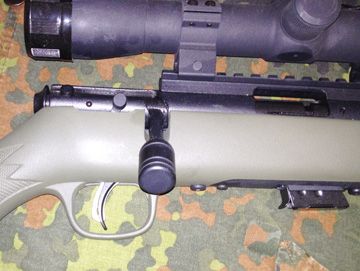
This Savage .22 is similar to just about any other bolt action I have ever fired with one BIG addition, this rifle features an over-sized bolt handle that has proved to be worthy of mentioning and making a big review point about. Check out that Weaver/Picatinny type rail mount, that comes with the factory rifle.

Quality - Top notch high quality fluted barrel, the magazine release is a bit cheesy as is the cheep plastic stock. We were forced to use sand paper an a big dowel to sand out the barrel channel in the cheep stock to get a reliable free-float. The Savage Mark II FV-SR has a steel receiver made of good quality material as is the bolt itself. Both the receiver and bolt are a bit typical in the lack of refined edge de-burring, finishing work, and polish (I guess we just cannot expect what was normal in the 1950’s). The magazine is made of steel and is of high quality and as described works great.
Caliber/Ammunition - .22 LR is comparatively inexpensive ammunition with almost no recoil. Of course bulk-box .22 LR is available at any big-box store great fun for the range and can be reasonably accurate. If you choose target grade ammunition try out several types, speed, weight and brand for accuracy that is often hard to believe. High velocity .22 LR is effective for hunting and available in hollow points that actually work at shorter ranges.

Did I mention accurate - how about 10 rounds at 25 yards... I added that green square to gauge the measurement, that is an inch! This target was punched with a premium target-grade lead bullet selection, the best of 12 different brands, weights, and speeds (FPS) we tested.
Use - Easy to strip and clean, but the main attractant is the adjustable “Accu-trigger” I cannot say how impressed I have been with this addition to Savage products, it takes this little bolt action to the next level. One nice touch is that this particular rifle comes with a STANDARD scope mount already factory installed anything is better than the stupid air gun cuts that are normal.
Current production - Available now, have your local gun shop - order yourself one.
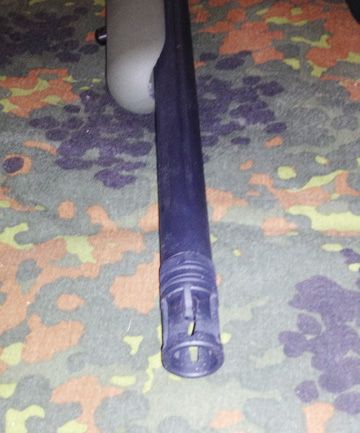
Additional points - This is a silencer ready rifle with threads at the end of the barrel for 1/2 28 and are machined true to the barrel (important to prevent baffle strikes). I was never a big fan of “silencers” I remember the ones from the 1980’s as heavy, easy to damage, and just not all that effective (far louder than any of the movie crap). I have several friends and two relatives that have become “converts” to the “brotherhood of science” and took the plunge and got the BATFE stamp - I am suitably impressed with the modern silencers available now that I am considering filling out paperwork myself. Below is the little rifle with a typical AR birdcage used here to protect the threads.


Personal - I have posted in the past about how the lowly .22 lr is my "secret sin,” to this day the simple act of hunting, shooting or plinking with .22 firearms is my “hands down” favorite way to spend my shooting time.
In the last few years I have been spending quite a bit of money and time thinking about, researching, testing and shooting to find the “best .22 rifle” for prepping. I am never sure just what makes something “the best” because the subjective nature of our personal bias and the almost endless applications that could be applied to test “the best” it is an enigma.
Because I was never happy with the accuracy of the semi-auto rifles I got rid of all but two and replaced them with bolt action rifles two of them you see above. I habitually and continually end up with the bolt action .22 rifles again and again. Even with the recent and mostly successful try with the Marlin autoloading .22 rifles - the accuracy was just not in the same class with the bolt actions.
Function - Mongo grab bolt, Mongo turn bolt, Mongo pull trigger with bugger hook, fire stick go BOOM there is something elegant in the simple function of the bolt action rifles.
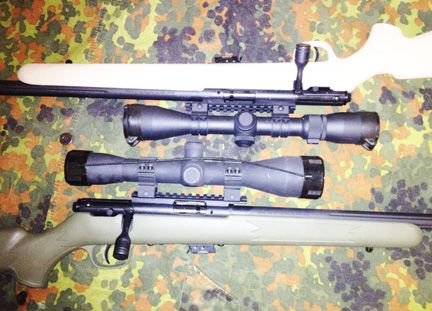
The top rifle is wearing a 3x9 one inch Nikon Buckmasters and the bottom rifle in green is attached to a fixed 6 power scope with a 30 mm tube. The rifles come with the plastic stocks shown, but the colors we added later. The Savage is simply excellent in it’s reliable function, the five round magazine fed without scraping or deformation and sent the rounds perfectly into the chamber.
This Savage .22 is similar to just about any other bolt action I have ever fired with one BIG addition, this rifle features an over-sized bolt handle that has proved to be worthy of mentioning and making a big review point about. Check out that Weaver/Picatinny type rail mount, that comes with the factory rifle.
Quality - Top notch high quality fluted barrel, the magazine release is a bit cheesy as is the cheep plastic stock. We were forced to use sand paper an a big dowel to sand out the barrel channel in the cheep stock to get a reliable free-float. The Savage Mark II FV-SR has a steel receiver made of good quality material as is the bolt itself. Both the receiver and bolt are a bit typical in the lack of refined edge de-burring, finishing work, and polish (I guess we just cannot expect what was normal in the 1950’s). The magazine is made of steel and is of high quality and as described works great.
Caliber/Ammunition - .22 LR is comparatively inexpensive ammunition with almost no recoil. Of course bulk-box .22 LR is available at any big-box store great fun for the range and can be reasonably accurate. If you choose target grade ammunition try out several types, speed, weight and brand for accuracy that is often hard to believe. High velocity .22 LR is effective for hunting and available in hollow points that actually work at shorter ranges.

Did I mention accurate - how about 10 rounds at 25 yards... I added that green square to gauge the measurement, that is an inch! This target was punched with a premium target-grade lead bullet selection, the best of 12 different brands, weights, and speeds (FPS) we tested.
Use - Easy to strip and clean, but the main attractant is the adjustable “Accu-trigger” I cannot say how impressed I have been with this addition to Savage products, it takes this little bolt action to the next level. One nice touch is that this particular rifle comes with a STANDARD scope mount already factory installed anything is better than the stupid air gun cuts that are normal.
Current production - Available now, have your local gun shop - order yourself one.
Additional points - This is a silencer ready rifle with threads at the end of the barrel for 1/2 28 and are machined true to the barrel (important to prevent baffle strikes). I was never a big fan of “silencers” I remember the ones from the 1980’s as heavy, easy to damage, and just not all that effective (far louder than any of the movie crap). I have several friends and two relatives that have become “converts” to the “brotherhood of science” and took the plunge and got the BATFE stamp - I am suitably impressed with the modern silencers available now that I am considering filling out paperwork myself. Below is the little rifle with a typical AR birdcage used here to protect the threads.
Wednesday, April 13, 2011
Bug Out Bag essentials - the backpack cooking stove
More reviews and demonstrations of backpacking stoves and types.
The Wood burning backpacking stoves.
Vargo Hexagon Wood Stove, similar to the steel folding stove, this type of stove uses small pieces of scrap wood. Easy to carry and fuel is available scrap, same drawback as wood - smoke.
The alcohol backpacking stoves.
Require a fuel to be packed, easy to light, fast, hot, and clean burning - no smoke.
The Wood burning backpacking stoves.
Vargo Hexagon Wood Stove, similar to the steel folding stove, this type of stove uses small pieces of scrap wood. Easy to carry and fuel is available scrap, same drawback as wood - smoke.
The alcohol backpacking stoves.
Require a fuel to be packed, easy to light, fast, hot, and clean burning - no smoke.
Tuesday, April 5, 2011
The 72 hour kit (Bug-out-bag)
From San Fran the 72hours.org site.
72hours.org
The Best Preparedness magazine out there. (Just ignore Mas, the token collectivist)
www.backwoodshome.com
Disaster preparation!
More on this later.
72hours.org
The Best Preparedness magazine out there. (Just ignore Mas, the token collectivist)
www.backwoodshome.com
Disaster preparation!
Tips for choosing a backpack
Start with questions for yourself.
Do you need a backpack?
There are other options, not the least of them is the "rickshaw" or "game cart". You can carry more weight with a rickshaw cart, but the wheels can limit you in the locations you can go, a backpack will go where you go, but you will not be able to carry as much weight.
How much "stuff" will I need to pack?
How many pockets and how much do you need to carry? If alone, you will carry more, but take a hint and drop as much as you can, carry only what you need - study the ultra-light backpackers and the "live on the land" type of trekkers for tips and tricks.
Think about what you need, and consider outside strapping and internal size that may be required.
There is a general "rule of thumb" you will see with pack manufacturers but I find that if you do it correctly you can go the next size under.
A single "day hike" or "overnighter" to about one week (adding food from plants or fishing/hunting) or in places where you need tools or equipment would require packs in the range of 1,800-2,500 cubic inch (30-40 liters) internal space. Adding outside strapping for odd tools this need could be less than half for short trips...
A pack in hike where you will be spending more that two days you may want to consider a pack in the size of 3,000-5,000 cubic inch (50-80 liters), this is a relatively large pack, personally I have never had a pack larger than 4,800 cubic inches and you can keep up with three weeks of food (if you are adding to that with local plants and or fishing/hunting).
Packs that are more than 5,000 cubic inch (80 liters and more) capacity would be almost "expedition" level packs, or packs where a large amount of tools, shelter, or clothing would be required.
What type of backpack?
Any pack (regardless of type) that is adjusted incorrectly will cause you pain and be difficult to take for long periods of traveling.
All packs are designed to place a majority of the weight on your hip belt! Both internal and external frame packs should have tight fitting, well padded, well designed hip belts! DO NOT depend on the shoulder straps to carry the weight for long periods of time.
There are two basic types of advanced backpacks the internal frame type and the external frame type.
Internal frame backpacks.
Internal frame backpacks are currently the most popular, take care to fit your pack correctly as an internal frame MUST BE adjusted correctly for you, and often you will need to try several packs out to find one that "fits". It is harder to find a well fitting internal frame pack than you would think - go to a store to check them out, be aware that many who will "help you" are one or two season packers, they may not take into account your needs for all seasons. "Four season" equipment is designed for Winter PLUS the other seasons, all other "season" levels are for less demanding camping seasons. Remember camping is considered a recreational activity in the US, take this into consideration when you get advice from well traveled backpackers.
The internal frame packs are typically lower slung, narrow, and will balance well for walking, even when climbing hills and rocks or steep trails. You will be likely to travel along narrow trails quicker and the pack will allow you to even stoop, crawl, or drag yourself in a low crawl without removing the pack (if the space is large enough for you and the pack, it is closer to your body but it does not disappear).
Drawbacks to internal frame packs are related to its lack of a frame, it sits closer to your body and will cause you to perspire, this can be a killer in the winter if you wet your clothing, I made a trip many years ago in winter and got wet, that first night was the most miserable I have ever experienced, I could not get warm and I did not have "night dress" or a bag liner so I could strip down and get the wet clothes off... That was also the last internal frame pack I ever used in cold weather.
Internal frame packs will also not carry as much weight as an external frame pack will, you also must place the heavy items to the bottom of the pack to keep the balance internal frame packs are capable of providing.
Because they are popular, there are many internal frame packs to choose from, the models used by the military are heaver, poorly designed, and unless you happen to be "standard size" poor fitting, for the money there are many choices available that would be a better fit and design (they just come in crap colors - this is an easy fix with a waterproof pack cover).
External frame backpacks.
External frame backpacks over the years have lost their popularity, with the exception of winter trekkers and hunters.
It is easier to find a well fitting external frame pack often getting a great match without having to go to a store to check twenty pack brands and sizes. External frame backpacks just as internal frame are not specifically rated by season, but there are reasons I would place the external frame pack style as a "Four season" pack. Winter has its own sets of demands and ventilation away from winter clothing is the number one reason for an external frame pack, with the ability to carry much more weight in a more "hiker mule" fashion.
The external frame packs typically ride much higher on the back, are wider. External frame packs will balance high and are great for heavy weights on more even ground, they are not particularly well suited for climbing hills and rocks or steep trails. You will be forced to consider travel along narrow trails with detail and forethought, because a high riding heavy pack will require you to remove the pack for small spaces and may even have to drag a pack behind you if the space is low enough.
Drawbacks and benefits to external frame packs center on the rigid frame. The rigid frame will help control perspiration by keeping the pack off your clothing and body except for the main contact points. In winter a rigid frame pack is almost a requirement. The pack is removable from the frame and the frame can be used to pack our large items - one reason the external frame packs are so popular with hunters.
External frame packs will easily carry double the weight an internal frame pack is capable of carrying and will carry that weight more comfortably for the user. Be careful not to place too many heavy items at the top of the pack, an make your self any more top heavy and off balance than is necessary..
Because there are fewer models of external frame packs available, there is a huge price varriance, strangely some of the best designs for external frame packs are the LEAST EXPENSIVE! The models used by the military are heavy, pathetically ill designed, and poor fitting. Just as with internal frame packs there are many superior packs for the money than are available as military surplus.
I suggest some of the least expensive packs as starters, as strange as it sounds I have come full circle back to the inexpensive external frame packs as my main use pack now.
I use the Outdoor Products "Saturn" external frame style pack, as the frame is flexible and I broke my last Cabela "Extreme Alaskan Outfitter" when I fell back on it against a rock wall - that is the last expensive pack I get, next trip I used my son’s Outdoor Products "Saturn" and decided I would get one for myself - a bit heavy (5.5 lbs empty) but flexible and I enjoy it far more than any other external frame pack I have ever used.
There is no need to pitch out five to seven hundred bucks for a pack!
Try this link for Outdoor products inexpensive but good and useable packs, from one of my favorite camping suppliers on the web - Campmor.
Campmor Outdoor Supply
Do you need a backpack?
There are other options, not the least of them is the "rickshaw" or "game cart". You can carry more weight with a rickshaw cart, but the wheels can limit you in the locations you can go, a backpack will go where you go, but you will not be able to carry as much weight.
How much "stuff" will I need to pack?
How many pockets and how much do you need to carry? If alone, you will carry more, but take a hint and drop as much as you can, carry only what you need - study the ultra-light backpackers and the "live on the land" type of trekkers for tips and tricks.
Think about what you need, and consider outside strapping and internal size that may be required.
There is a general "rule of thumb" you will see with pack manufacturers but I find that if you do it correctly you can go the next size under.
A single "day hike" or "overnighter" to about one week (adding food from plants or fishing/hunting) or in places where you need tools or equipment would require packs in the range of 1,800-2,500 cubic inch (30-40 liters) internal space. Adding outside strapping for odd tools this need could be less than half for short trips...
A pack in hike where you will be spending more that two days you may want to consider a pack in the size of 3,000-5,000 cubic inch (50-80 liters), this is a relatively large pack, personally I have never had a pack larger than 4,800 cubic inches and you can keep up with three weeks of food (if you are adding to that with local plants and or fishing/hunting).
Packs that are more than 5,000 cubic inch (80 liters and more) capacity would be almost "expedition" level packs, or packs where a large amount of tools, shelter, or clothing would be required.
What type of backpack?
Any pack (regardless of type) that is adjusted incorrectly will cause you pain and be difficult to take for long periods of traveling.
All packs are designed to place a majority of the weight on your hip belt! Both internal and external frame packs should have tight fitting, well padded, well designed hip belts! DO NOT depend on the shoulder straps to carry the weight for long periods of time.
There are two basic types of advanced backpacks the internal frame type and the external frame type.
Internal frame backpacks.
Internal frame backpacks are currently the most popular, take care to fit your pack correctly as an internal frame MUST BE adjusted correctly for you, and often you will need to try several packs out to find one that "fits". It is harder to find a well fitting internal frame pack than you would think - go to a store to check them out, be aware that many who will "help you" are one or two season packers, they may not take into account your needs for all seasons. "Four season" equipment is designed for Winter PLUS the other seasons, all other "season" levels are for less demanding camping seasons. Remember camping is considered a recreational activity in the US, take this into consideration when you get advice from well traveled backpackers.
The internal frame packs are typically lower slung, narrow, and will balance well for walking, even when climbing hills and rocks or steep trails. You will be likely to travel along narrow trails quicker and the pack will allow you to even stoop, crawl, or drag yourself in a low crawl without removing the pack (if the space is large enough for you and the pack, it is closer to your body but it does not disappear).
Drawbacks to internal frame packs are related to its lack of a frame, it sits closer to your body and will cause you to perspire, this can be a killer in the winter if you wet your clothing, I made a trip many years ago in winter and got wet, that first night was the most miserable I have ever experienced, I could not get warm and I did not have "night dress" or a bag liner so I could strip down and get the wet clothes off... That was also the last internal frame pack I ever used in cold weather.
Internal frame packs will also not carry as much weight as an external frame pack will, you also must place the heavy items to the bottom of the pack to keep the balance internal frame packs are capable of providing.
Because they are popular, there are many internal frame packs to choose from, the models used by the military are heaver, poorly designed, and unless you happen to be "standard size" poor fitting, for the money there are many choices available that would be a better fit and design (they just come in crap colors - this is an easy fix with a waterproof pack cover).
External frame backpacks.
External frame backpacks over the years have lost their popularity, with the exception of winter trekkers and hunters.
It is easier to find a well fitting external frame pack often getting a great match without having to go to a store to check twenty pack brands and sizes. External frame backpacks just as internal frame are not specifically rated by season, but there are reasons I would place the external frame pack style as a "Four season" pack. Winter has its own sets of demands and ventilation away from winter clothing is the number one reason for an external frame pack, with the ability to carry much more weight in a more "hiker mule" fashion.
The external frame packs typically ride much higher on the back, are wider. External frame packs will balance high and are great for heavy weights on more even ground, they are not particularly well suited for climbing hills and rocks or steep trails. You will be forced to consider travel along narrow trails with detail and forethought, because a high riding heavy pack will require you to remove the pack for small spaces and may even have to drag a pack behind you if the space is low enough.
Drawbacks and benefits to external frame packs center on the rigid frame. The rigid frame will help control perspiration by keeping the pack off your clothing and body except for the main contact points. In winter a rigid frame pack is almost a requirement. The pack is removable from the frame and the frame can be used to pack our large items - one reason the external frame packs are so popular with hunters.
External frame packs will easily carry double the weight an internal frame pack is capable of carrying and will carry that weight more comfortably for the user. Be careful not to place too many heavy items at the top of the pack, an make your self any more top heavy and off balance than is necessary..
Because there are fewer models of external frame packs available, there is a huge price varriance, strangely some of the best designs for external frame packs are the LEAST EXPENSIVE! The models used by the military are heavy, pathetically ill designed, and poor fitting. Just as with internal frame packs there are many superior packs for the money than are available as military surplus.
I suggest some of the least expensive packs as starters, as strange as it sounds I have come full circle back to the inexpensive external frame packs as my main use pack now.
I use the Outdoor Products "Saturn" external frame style pack, as the frame is flexible and I broke my last Cabela "Extreme Alaskan Outfitter" when I fell back on it against a rock wall - that is the last expensive pack I get, next trip I used my son’s Outdoor Products "Saturn" and decided I would get one for myself - a bit heavy (5.5 lbs empty) but flexible and I enjoy it far more than any other external frame pack I have ever used.
There is no need to pitch out five to seven hundred bucks for a pack!
Try this link for Outdoor products inexpensive but good and useable packs, from one of my favorite camping suppliers on the web - Campmor.
Campmor Outdoor Supply
The BOB/GOOD tarp-tent and hammock DIY project

After years of searching or a backpacking tent that worked well, the hammock tent is comfortable, easy to make, lightweight, great for foul weather, and can even be used on the ground as a regular tent if needed. Bug and snake proof and more comfortable than the ground, works well in cold weather also when set up correctly with an under-sling bag.
See project here...
Down and dirty, get ready now!
Monday, April 4, 2011
The camping hammock part 2
Here are some young campers reviewing a tent/hammock of a commercial manufacturer, they point out well the single problem with hammock camping - cold, most of this can be solved with planning.
As I posted before I make my own, and you can review the many designs out there.
Here is the link again for the bridge style hammock that is quite popular.
The camping hammock
To answer a few of you I am not promoting simply this product, but the IDEA of the hammock in a pack or 72 hour kit...
I make my own...
If you need to buy one because you don't have time, or the equipment... I get most of my camping gear from Campmor. Simply type hammock into the search and there are several hammocks to pick from, or even my preference the hammock tent setups.
Entrenching tools
The entrenching tool or pack shovel - something I would never be without, I have one in every car. Every member of the family has one for their backpack, though when we pack in we only carry two and leave the other three to use that weight for other items, in a bug-out situation every pack would have one.
An entrenching tool is a must have tool, the two reviewed in this blog can be sharpened and used as a hatchet if needed (I posted about hand saws vs. hatchets).
I am a big supporter of the Cold Steel shovel because as you can tell from the photos they are well used (and abused) and hold up very well. They double as a small axe and the sharpened blades dig very well, a great tool for building shelters.
Like everyone else I always want to try out the "new and great" and bought one of the Glock brand e-tools (thats Entrenching tool BTW).
Without a doubt it is a great tool, an excellent shovel and you can tell by the photos it is the most used shovel of the bunch, it is also the second oldest (the oldest e-tool is an east german similar to the Cold Steel shovel and it is regulated to the car emergency box as I beat it all to hell).
The main thing you would ask is - would I recommend it? Honestly ONLY if you need to save the weight! I think the Cold steel shovel is a better performer at a much lower price! The advantages of the Glock are the light weight, adjustable blade, smaller compacted size (the handle extends and locks), and an included saw-blade (pictured below) that stores in the handle and attached with a screw cap to the end of the shovel. The Glock I think also would not hold up to the same abuse to the blade as the Cold Steel shovel as the blade attaches at the end while the Cold Steel has an extended metal bracing that fits over the handle making it a fixed length.
I would not even consider any of the cheep e-tools for camping (and they are often more expensive than the Cold Steel shovel) and that triangle folder that is surplus is awkward to hold, almost useless as a weapon, sucks to dig with and is not even close to the long lasting quality of the two featured here. The only folding shovel I would ever buy again would be another Glock. Look well across the internet for good prices, it is not uncommon to find the Glock for under 35 bucks and the Cold Steel under 18 bucks.
An entrenching tool is a must have tool, the two reviewed in this blog can be sharpened and used as a hatchet if needed (I posted about hand saws vs. hatchets).
I am a big supporter of the Cold Steel shovel because as you can tell from the photos they are well used (and abused) and hold up very well. They double as a small axe and the sharpened blades dig very well, a great tool for building shelters.
Like everyone else I always want to try out the "new and great" and bought one of the Glock brand e-tools (thats Entrenching tool BTW).
Without a doubt it is a great tool, an excellent shovel and you can tell by the photos it is the most used shovel of the bunch, it is also the second oldest (the oldest e-tool is an east german similar to the Cold Steel shovel and it is regulated to the car emergency box as I beat it all to hell).
The main thing you would ask is - would I recommend it? Honestly ONLY if you need to save the weight! I think the Cold steel shovel is a better performer at a much lower price! The advantages of the Glock are the light weight, adjustable blade, smaller compacted size (the handle extends and locks), and an included saw-blade (pictured below) that stores in the handle and attached with a screw cap to the end of the shovel. The Glock I think also would not hold up to the same abuse to the blade as the Cold Steel shovel as the blade attaches at the end while the Cold Steel has an extended metal bracing that fits over the handle making it a fixed length.
I would not even consider any of the cheep e-tools for camping (and they are often more expensive than the Cold Steel shovel) and that triangle folder that is surplus is awkward to hold, almost useless as a weapon, sucks to dig with and is not even close to the long lasting quality of the two featured here. The only folding shovel I would ever buy again would be another Glock. Look well across the internet for good prices, it is not uncommon to find the Glock for under 35 bucks and the Cold Steel under 18 bucks.
The Gurkha Kukri and variants
The Gurkha Kukri is a cross, almost a short sword larger than a knife and useful as a small hatchet or machete (although much heavier than a machete).

Above is pictured one of my prized knife collection participants, a Blackjack Marauder MK II 15" Gurkha Kukri variant with a custom blackened blade made by Harumi Suzuki of Japan (the original Blackjack knives).
I bought this monster in the early 1990's at a gun show, just as a fluke from Blackie Collins (who had a booth set up with his and other mixed knives). I had known Blackie for years as we both dive and would talk about diving. I bought the Blackjack, a Blackie Collins Wenoka knife and this strange little neck knife for SCUBA divers that Blackie designed he called the Buddy System (the one I have is the first series model).
The only current maker I know of producing a model similar to the Blackjack Marauder is Cold Steel with their version of the Gurkha Kukri (I have been warned the Smith & Wesson versions are particularly bad). While I consider the Marauder a great addition to my collection I would not suggest buying such an expensive UTILITY TOOL there are other great options like the conversion you can see here on M40's pages. BudK has them for a low price ready for modification. (In fact I recommend M40's pages for lots of projects and tips). Contrary to M40s page the Blackjack Marauder MK II is not “just over 1/8 of an inch” but a full 3/16 inch thick (at least the early 1990s versions).

Above is pictured one of my prized knife collection participants, a Blackjack Marauder MK II 15" Gurkha Kukri variant with a custom blackened blade made by Harumi Suzuki of Japan (the original Blackjack knives).
I bought this monster in the early 1990's at a gun show, just as a fluke from Blackie Collins (who had a booth set up with his and other mixed knives). I had known Blackie for years as we both dive and would talk about diving. I bought the Blackjack, a Blackie Collins Wenoka knife and this strange little neck knife for SCUBA divers that Blackie designed he called the Buddy System (the one I have is the first series model).
The only current maker I know of producing a model similar to the Blackjack Marauder is Cold Steel with their version of the Gurkha Kukri (I have been warned the Smith & Wesson versions are particularly bad). While I consider the Marauder a great addition to my collection I would not suggest buying such an expensive UTILITY TOOL there are other great options like the conversion you can see here on M40's pages. BudK has them for a low price ready for modification. (In fact I recommend M40's pages for lots of projects and tips). Contrary to M40s page the Blackjack Marauder MK II is not “just over 1/8 of an inch” but a full 3/16 inch thick (at least the early 1990s versions).
Why talk about this as a tool and then mention a less expensive version?
Because it is a tool, and at a low price it gives you a nice project to work on and you will get a great tool made by hand in most cases out of old leaf springs from trucks (the steel is of good quality as a matter of fact and makes a good blade).
I will be following this with what I have have started using in replacement of this monster - the Cold Steel Norse Hawk or the Hand forged throwing tomahawks or an entrenching tool. Two things prompted this weight and environment, the Blackjack is heavy and the areas where we camp are forested with less undergrowth so a hatchet is more useful than a machete like tool.
Water, water, water
Our friends over at American Apocalypse posted about a drip water kit available from an on-line dealer, I was able to find out that you can order this from the manufacturer directly.
Ceramic Drip-Filter
"It is described as, "A ceramic, half-micron water filter. The micron removes water-borne bacterium. The inside of the filter is loaded with different media or ingredients, such as man-made carbons, mother nature carbons and man-made resins. Those different resins and carbons remove the different contaminants in the water."
See Filter Specifications
See Detailed Assembly Instructions
Ceramic Candle Water Filter
Personal Critical Review of Firearms - SMLE Lee-Enfield rifles

Short Magazine Lee-Enfield Rifle
I am going to talk only at a general level, I don't want to go into the SMLE variants there are too many.
Personal - Ugly, sorry but I think this rifle is about the ugliest bolt action rifle ever designed. I dislike the cock on closing bolt. I have owned or fired several of the many versions, I liked the Indian .308 version the best (Ishapore .308 rifles were cheep as dirt a few years ago) I also found it to be the most accurate of any I have shot. I dislike rimmed cartridges and unlike the 7.62r used in the Mosin-Nagant the .303 is a bit anemic for the size.
Function - it's a bolt action, as long as the ammo does not damage the gun, everything is in safe working order, and the feeding is unimpaired the user is all that is needed. Like the Mauser, 1903A3, and Mosin-Nagant they can be dependable and accurate if in good condition and well made.
Design flaws - Rear locking requires good metallurgy in the bolt, a poorly made bolt of inferior metals can be unsafe to fire.
Quality - depending on the maker quality is all over the map, many of the third world copies are poorly made and older service rifles can be damaged or poorly maintained.
Caliber/Ammunition - .303 is an obsolete rimmed round and surplus ammunition can be of questionable quality. The .303 is a serviceable cartridge for hunting and defense capable of good accuracy, because of its primitive design it can be used well with cast lead, paper patched bullets and black powder.
Use - again this is a bolt action, a trained monkey could operate this rifle, poorly made or maintained rifles can be nominal in accuracy and many in good working order are extremely accurate.
Current Production - This is an obsolete rifle, but the numbers of former production are huge, literally tons of rifles exist, there are two obscure small manufacturers that produce new models one makes a version that uses AK mags and fires the 7.62x39 round (they may have stopped production) and one company that makes a new .308 version.
I would consider this rifle a good possible trade item and a "throw down" for arming friendlies, not even a secondary choice for MBR, without a doubt I would consider the SVT40, M1, FN49 or even the SKS a better secondary choice.
Building a firearm collection for preparedness Part 2
More thoughts on a collection for preparedness and additions.
1. Caliber compatibility - the more weapons that share ammunition the easier it is to store and keep a handle on.
2. How is the caliber ranked for range and power? (suitability for large US game for hunting)
3. Is it suitable for reloading? (hand-loading used brass)
4. Is it readially available? (both weapons and ammunition)
5. What is the cost vs. value?
6. Are there auto-loading rifles and or magazines available in this caliber? (ten rounds and up)
7. Will there be sources of ammunition later and if not is this a concern?
8. Are reliable weapons with spare parts available (for spare/repair parts stocking)
9. Are they reasonably accurate? - 20 rounds 8 inches in less than two min. (That will kick out a bunch of rifles).
We are not talking about delusions of the mall ninjas - I for one will be bugging in place if the need arises. We want to think about how many uses this can be matched to and if they fit the needs of your area.
I hand-load/reload so even current availability issues are almost always limited to concerns pertaining to the availability of components rather than new or surplus ammunition.
I have posted before, pistols just don't hold the same interest for me as rifles, I have them, I think they are necessary, but I don't put much stock in them past that possible "oh, crap" situation - like an attempted car-jacking or similar problem, and as I said it would be a last resort only if the fear of harm is imminent and then "no sword is sheathed without drawing blood" concept applies - the proper tool at the proper time, only when needed.
I also was looking over the load books to confirm and here is the general run down I found (changes from book to book, but they generally follow this trend).
7.62x54R Ballistic performance
Bullet weight/type 150 gr
Velocity 3,000 ft/s
Energy 2,905 ft·lbf
The two highest are 7.62x54R and 7.92x57 then 30-06 and then 7.62x51 - if you look at commercial .308 rather than 7.62x51 then you find that it comes within and in some cases surpass 30-06. (again this could be problematic or dangerous for weaker actions such as the M1a or older rifles like the Spanish 7.62x51 conversion Mausers)
1. Caliber compatibility - the more weapons that share ammunition the easier it is to store and keep a handle on.
2. How is the caliber ranked for range and power? (suitability for large US game for hunting)
3. Is it suitable for reloading? (hand-loading used brass)
4. Is it readially available? (both weapons and ammunition)
5. What is the cost vs. value?
6. Are there auto-loading rifles and or magazines available in this caliber? (ten rounds and up)
7. Will there be sources of ammunition later and if not is this a concern?
8. Are reliable weapons with spare parts available (for spare/repair parts stocking)
9. Are they reasonably accurate? - 20 rounds 8 inches in less than two min. (That will kick out a bunch of rifles).
We are not talking about delusions of the mall ninjas - I for one will be bugging in place if the need arises. We want to think about how many uses this can be matched to and if they fit the needs of your area.
I hand-load/reload so even current availability issues are almost always limited to concerns pertaining to the availability of components rather than new or surplus ammunition.
I have posted before, pistols just don't hold the same interest for me as rifles, I have them, I think they are necessary, but I don't put much stock in them past that possible "oh, crap" situation - like an attempted car-jacking or similar problem, and as I said it would be a last resort only if the fear of harm is imminent and then "no sword is sheathed without drawing blood" concept applies - the proper tool at the proper time, only when needed.
I also was looking over the load books to confirm and here is the general run down I found (changes from book to book, but they generally follow this trend).
7.62x54R Ballistic performance
Bullet weight/type 150 gr
Velocity 3,000 ft/s
Energy 2,905 ft·lbf
The 7.92x57mm IS (8mm Mauser) Ballistic performance
Bullet weight/type (.323 inch) 181 gr
Velocity 2,700 ft/s
Energy 2,902 ft·lbf
30-06 Ballistic performance
Bullet weight/type 150 gr
Velocity 2,900 ft/s
Energy 2,820 ft·lbf
Bullet weight/type (.323 inch) 181 gr
Velocity 2,700 ft/s
Energy 2,902 ft·lbf
30-06 Ballistic performance
Bullet weight/type 150 gr
Velocity 2,900 ft/s
Energy 2,820 ft·lbf
30-06 Ballistic performance (M2 ball cartridge)
Bullet weight/type 152 gr
Velocity 2,740 ft/s
Energy 2,650 ft·lbf
Bullet weight/type 152 gr
Velocity 2,740 ft/s
Energy 2,650 ft·lbf
7.62x51 (.308) Ballistic performance
Bullet weight/type146.6 gr
Velocity 2,756 ft/s
Energy 2,472 ft·lbf
Bullet weight/type146.6 gr
Velocity 2,756 ft/s
Energy 2,472 ft·lbf
Note this information is for "time era" factory or surplus loadings, modern loads designed for modern powders in new manufacture bolt action rifles can "UP" the power of the 30-06 but this would be damaging or dangerous in the M1, M1917, or 03A3.
The two highest are 7.62x54R and 7.92x57 then 30-06 and then 7.62x51 - if you look at commercial .308 rather than 7.62x51 then you find that it comes within and in some cases surpass 30-06. (again this could be problematic or dangerous for weaker actions such as the M1a or older rifles like the Spanish 7.62x51 conversion Mausers)
The common thought out there is that 30-06 is the most potent, but the numbers prove that the Russian round is the hottest. Also contrary to popular misinformation .308 commercial rounds have a higher pressure and loading parameters than the NATO rounds and so would chart higher.
Using the basic thoughts and my already chosen calibers I was thinking about getting one of the new Remington .223 pump action rifles that takes an AR magazine and a .308 bolt action rifle from Savage. I would order both with iron sights, this would be the logical thing, but there is the CZ52 and the PPSH41 semi-auto I have been eyeballing (to satisfy my curiosity). Logic may prevail and I may get a second SU16CA as it is cheeper than the Remington, and I may get one or two of the Spanish Mausers in .308.
As to shotguns - I had forgotten to list them, you need one. I don't have one for myself but, my wife has an 870 riot gun for home protection (yes it is hers, she made me buy one for her) and my oldest son has an 870 pump fitted with a slug barrel that has interchangeable choke tubes, both are 12 ga. and are in almost unused condition, simply because we don't use them.
And a high power pellet rifle - I was never a good shot on the wing with a shotgun, but if it lights and I have a post and notch on it, it's in the bag. I note the preponderance of pidgins in our area and in a pinch you would have a hard time telling the meat from a dove.
Using the basic thoughts and my already chosen calibers I was thinking about getting one of the new Remington .223 pump action rifles that takes an AR magazine and a .308 bolt action rifle from Savage. I would order both with iron sights, this would be the logical thing, but there is the CZ52 and the PPSH41 semi-auto I have been eyeballing (to satisfy my curiosity). Logic may prevail and I may get a second SU16CA as it is cheeper than the Remington, and I may get one or two of the Spanish Mausers in .308.
As to shotguns - I had forgotten to list them, you need one. I don't have one for myself but, my wife has an 870 riot gun for home protection (yes it is hers, she made me buy one for her) and my oldest son has an 870 pump fitted with a slug barrel that has interchangeable choke tubes, both are 12 ga. and are in almost unused condition, simply because we don't use them.
And a high power pellet rifle - I was never a good shot on the wing with a shotgun, but if it lights and I have a post and notch on it, it's in the bag. I note the preponderance of pidgins in our area and in a pinch you would have a hard time telling the meat from a dove.
Building a firearm collection for preparedness
I don't think I need to convince many of you of the possible urgent need to build a collection for preparedness, my view is that we are about to see something of a magnitude not seen in several generations.
With that in mind I wanted to review a few ideas, until now I have shared with others only in private.
What would I do now?
A good question I would want to look at it several ways, I live in a western state that does not have the restrictions of other un-constitutionally infested areas suffer from so I may be free to gather some items not allowed in some states or countries where you may be reading this...
I should start out by saying that I find rifles far more utilitarian than a pistol, but I would suggest a pistol you find comfortable. I do not think you have to have a .40 (something) to be a man - in fact a pistol is a piss poor tool for fighting your way back to the rifle you stupidly left out of reach (my grandfather taught me that).
Pistols first
That said there are reasons to have a pistol and to even apply for your stolen freedoms with a "permit", often just the extraction of your sidearm from its concealed holster will cause a "thug" to back down, but if ever threatened enough to think I ever needed to "pull" there would be no time to back down because that time would have already passed.
I favor the .357 revolver, and contrary to internet commandos, it is a very effective cartridge. The study of police fatal shootings shows the .357 to be far more lethal than most of the other rounds combined. I would gather that if you think the .357 is not "powerful" then you simply need to shoot a .357 with a 158 gr. HP full power load to see for yourself. I have hunted with a .357 in the past and it is a very effective round for hunting even large game. A very accurate round, if you put a scope on a .357 revolver NO ONE will laugh at you, contrary to the snickers you may get with a scope on an AK - there is a reason for that...
I am a fan of the 7.62x25mm Tokarev a hot version of the 7.63x25mm Mauser, very hot and very accurate
I like the 9x18mm Makarov, a small pistol that fires inexpensive ammunition, my wife favors her 9x18mm Makarov above all others.
I standardized on the 9x19mm Parabellum for the simple reason that it is a standard all over the world, ammo is available and inexpensive - not because it is better but because good pistols are easy to find and in the end any pistol is better than nothing. Future supply was the deciding factor.
Oh, and before you start busting my chops, I cut my teeth on .45 1911 pistols because that is what my dad loved, I gave up on the .45 the first time I shot my first .357 and never seriously looked back, and none of my .357 revolvers ever jammed on me - I could never say that about the 1911.
Regardless of what you choose, pick one, practice, stock up on ammo - I keep 500 rounds of factory loaded ammo (or more) for each pistol and components for lots more "home rolled".
You also need a .22 lr pistol - pick one and use it, cheep shooting, I suggest getting a revolver or auto loader to match your main pistol, they even make some conversion kits that are nice to have.
Rifles (damn, I love rifles)
First on the list get a .22 lr rifle in bolt or auto-loader, and continue to shoot it until you get past 2000 rounds before you even think about putting it to the side, take one every time you visit the range.
How would I do it?
I don't like the .223 and certainly don't like the AR platform, but I do (now) have one .223 that survived the recent sell off (I made a bit of coin off this panic and I am still selling and giving away) and it belongs to one of the small children. It is an SU16CA from Kel-tec, embarrassing for Rugar that Kel-tec can make a better rifle for less that uses standard magazines, and is more reliable than the jammin' jenny and more accurate than the POS mini-14 junker.
I did chose to make .308 my standard rifle caliber, but if I were to do this from scratch now I would choose the 7.62x54r...
Why? budget, effectiveness.
I would get an auto-loading mag fed rifle and several turn bolt Mosin Nagant 91/30, 91/59 or M44 rifles (and they are drying up in supply fast).
For the autoloader I would most likely get the Romanian PSL junker with a scope for less than 800 bucks, then sell the scope and replace it with a little 2 or 4 power fixed scope. In fact thinking about this issue with a compatriot I seriously considered selling off my .308 rifle for the cash and getting an Romanian PSL and a SVT40 with a hand full of Mosin Nagant 91/30 rifles for throw-downs.
If the Yugoslavian M76 in 8mm Mauser was less expensive the same thing could be done with 8mm and some M24/47 Yugoslavian Mauser turn bolts, but the autoloader and the ammo is a bit high.
With that in mind I wanted to review a few ideas, until now I have shared with others only in private.
What would I do now?
A good question I would want to look at it several ways, I live in a western state that does not have the restrictions of other un-constitutionally infested areas suffer from so I may be free to gather some items not allowed in some states or countries where you may be reading this...
I should start out by saying that I find rifles far more utilitarian than a pistol, but I would suggest a pistol you find comfortable. I do not think you have to have a .40 (something) to be a man - in fact a pistol is a piss poor tool for fighting your way back to the rifle you stupidly left out of reach (my grandfather taught me that).
Pistols first
That said there are reasons to have a pistol and to even apply for your stolen freedoms with a "permit", often just the extraction of your sidearm from its concealed holster will cause a "thug" to back down, but if ever threatened enough to think I ever needed to "pull" there would be no time to back down because that time would have already passed.
I favor the .357 revolver, and contrary to internet commandos, it is a very effective cartridge. The study of police fatal shootings shows the .357 to be far more lethal than most of the other rounds combined. I would gather that if you think the .357 is not "powerful" then you simply need to shoot a .357 with a 158 gr. HP full power load to see for yourself. I have hunted with a .357 in the past and it is a very effective round for hunting even large game. A very accurate round, if you put a scope on a .357 revolver NO ONE will laugh at you, contrary to the snickers you may get with a scope on an AK - there is a reason for that...
I am a fan of the 7.62x25mm Tokarev a hot version of the 7.63x25mm Mauser, very hot and very accurate
I like the 9x18mm Makarov, a small pistol that fires inexpensive ammunition, my wife favors her 9x18mm Makarov above all others.
I standardized on the 9x19mm Parabellum for the simple reason that it is a standard all over the world, ammo is available and inexpensive - not because it is better but because good pistols are easy to find and in the end any pistol is better than nothing. Future supply was the deciding factor.
Oh, and before you start busting my chops, I cut my teeth on .45 1911 pistols because that is what my dad loved, I gave up on the .45 the first time I shot my first .357 and never seriously looked back, and none of my .357 revolvers ever jammed on me - I could never say that about the 1911.
Regardless of what you choose, pick one, practice, stock up on ammo - I keep 500 rounds of factory loaded ammo (or more) for each pistol and components for lots more "home rolled".
You also need a .22 lr pistol - pick one and use it, cheep shooting, I suggest getting a revolver or auto loader to match your main pistol, they even make some conversion kits that are nice to have.
Rifles (damn, I love rifles)
First on the list get a .22 lr rifle in bolt or auto-loader, and continue to shoot it until you get past 2000 rounds before you even think about putting it to the side, take one every time you visit the range.
How would I do it?
I don't like the .223 and certainly don't like the AR platform, but I do (now) have one .223 that survived the recent sell off (I made a bit of coin off this panic and I am still selling and giving away) and it belongs to one of the small children. It is an SU16CA from Kel-tec, embarrassing for Rugar that Kel-tec can make a better rifle for less that uses standard magazines, and is more reliable than the jammin' jenny and more accurate than the POS mini-14 junker.
I did chose to make .308 my standard rifle caliber, but if I were to do this from scratch now I would choose the 7.62x54r...
Why? budget, effectiveness.
I would get an auto-loading mag fed rifle and several turn bolt Mosin Nagant 91/30, 91/59 or M44 rifles (and they are drying up in supply fast).
For the autoloader I would most likely get the Romanian PSL junker with a scope for less than 800 bucks, then sell the scope and replace it with a little 2 or 4 power fixed scope. In fact thinking about this issue with a compatriot I seriously considered selling off my .308 rifle for the cash and getting an Romanian PSL and a SVT40 with a hand full of Mosin Nagant 91/30 rifles for throw-downs.
If the Yugoslavian M76 in 8mm Mauser was less expensive the same thing could be done with 8mm and some M24/47 Yugoslavian Mauser turn bolts, but the autoloader and the ammo is a bit high.
Regardless, keep at least 1000 rounds for each rifle of factory loaded ammo and ONLY shoot reloads you have made for that rifle, keep the factory ammunition for when the need arises.
The reason for the turn bolt in the mix is for several reasons, one is for reloading, if in the worst case you had to shoot black powder and lead bullets you can load black powder, lead bullets (even paper patched/paper jacketed) and even press out primers knock out the firing pin dent and fill them with two or three toy cap gun caps and have a turn bolt rifle that functions. Damn, I hope it never gets down to black powder!
Just some random thoughts about the current situation, trying to look at this without a sense of panic but rather logic. I am afraid that this will be the last reasonable and possible chance before the hammer falls, in just a few weeks the first panic will subside (as it is now) and the second one will hit mid January. I write this knowing I have what I think I need, but I would have liked to keep my habit of trying out new rifles...
The reason for the turn bolt in the mix is for several reasons, one is for reloading, if in the worst case you had to shoot black powder and lead bullets you can load black powder, lead bullets (even paper patched/paper jacketed) and even press out primers knock out the firing pin dent and fill them with two or three toy cap gun caps and have a turn bolt rifle that functions. Damn, I hope it never gets down to black powder!
Just some random thoughts about the current situation, trying to look at this without a sense of panic but rather logic. I am afraid that this will be the last reasonable and possible chance before the hammer falls, in just a few weeks the first panic will subside (as it is now) and the second one will hit mid January. I write this knowing I have what I think I need, but I would have liked to keep my habit of trying out new rifles...
Sunday, April 3, 2011
BOB small game snare, dual use and inexpensive
Using fishing leaders as small game snares.
Snaring is illegal in many states in the USA. Possession of standard brass wire snares can create legal issues with the backpacker. Fishing leader while in possession of fishing line and hook will create for the backcountry hiker/backpacker both a useful fishing leader and an emergency small game snare if needed. Don't make the leaders into snares untill needed.
Snaring is illegal in many states in the USA. Possession of standard brass wire snares can create legal issues with the backpacker. Fishing leader while in possession of fishing line and hook will create for the backcountry hiker/backpacker both a useful fishing leader and an emergency small game snare if needed. Don't make the leaders into snares untill needed.
Subscribe to:
Posts (Atom)